



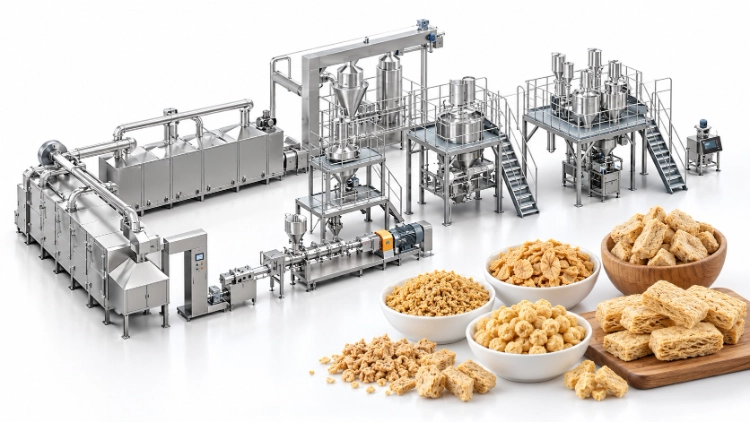
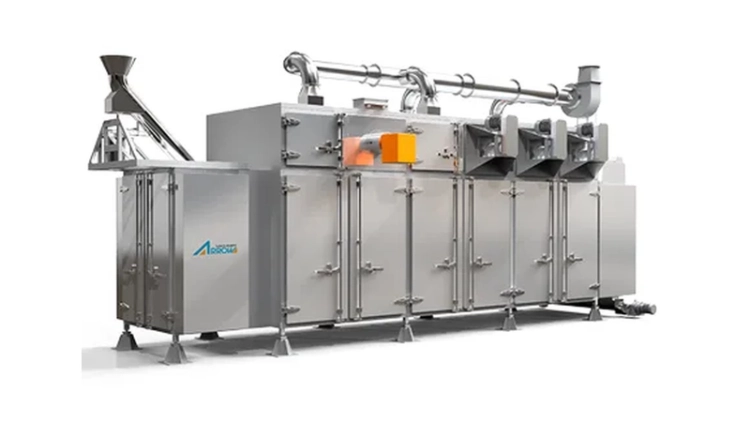
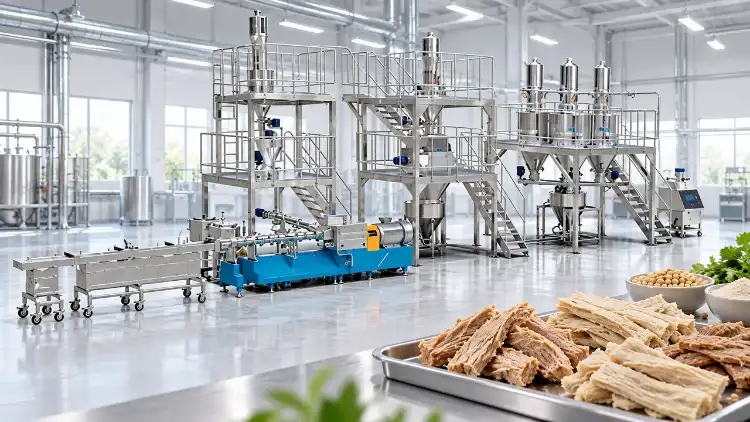
A pilot trial can produce a high moisture meat analog (HMMA) sample without proving the formula will run continuously at commercial output. High moisture meat analog production becomes more demanding as scale-up changes raw-material consistency, liquid dosing, thermal load, cooling-die duty, downstream handling, hygiene, and cold-chain logistics.
Scale-up is not a matter of copying one sample and multiplying its trial rate. It must preserve an approved product and process window while proving that the complete line can hold it continuously. This guide focuses on the checks needed before a plant-based meat line moves from trial to production.
What Must Be Locked Before Scale-Up Starts?
Define the Finished HMMA Product
Scale-up has no reliable starting point until the finished product is measurable. Define thickness, piece dimensions, directional texture, moisture range, density or bite, water retention, cutting format, and downstream use. Strips, whole-cut pieces, chunks, and minced bases may require different forming, cooling, cutting, and handling windows.
State which attributes are essential at launch. A whole-cut product may depend on visible fiber direction and edge integrity, while a minced base may emphasize dimensions, water retention, and clean cutting. This prevents the line from being designed around a vague phrase such as “meat-like texture.”
Separate the Approved Formula From Development Ideas
Separate the commercial launch formula from future product concepts. Identify the protein blend, liquid addition, oil or steam use where applicable, functional ingredients, and target moisture for the product that passed development review. Untested flavors, protein bases, or formats should be listed as options, not treated as validated requirements.
This distinction avoids paying for unverified flexibility while leaving a documented upgrade path. If a future SKU may need a different cooling profile, cutter, or packaging route, record it as a design consideration rather than proof that every condition is already validated.
Which Trial Data Should Be Carried Into Commercial Design?
Record the Material and Dosing Basis
A useful HMMA pilot trial records more than the final sample. Capture protein source, concentrate or isolate status, particle size, dry-ingredient ratios, water addition, oil or steam use where applicable, and actual feed rate. Soy, pea, wheat gluten, starches, and other components respond differently to hydration, shear, heat, and cooling.
Liquid dosing deserves particular attention. Changes in water distribution can alter feeding behavior, energy demand, pressure, structure, and cooling load. Record how liquids were introduced, how consistently they were delivered, and whether the production system will use the same dosing principle.
Record the Actual Process Window
Carry the measured trial window into the scale-up brief. Record feeder rate, screw speed, barrel temperatures, pressure where measured, motor load, liquid addition, cooling conditions, dimensions, and texture observations. Note which readings changed during startup or later in the run.
These records are engineering evidence, not a universal HMMA recipe. A trial that reports only one speed and one sample photograph gives a supplier too little information to judge feed stability, heat transfer, cooling demand, or commercial risk.
Why Does Extruder Scale-Up Need More Than a Capacity Number?
Larger Output Changes Material and Energy Flow
High moisture extrusion scale-up changes the movement of material, water, and heat. Feed stability, mixing, moisture distribution, motor load, pressure, residence behavior, and cooling demand may change when a pilot unit becomes a production extruder. A pilot rate multiplied by ten is not automatically validated for production.
The commercial question is whether the larger system can deliver the same product within an acceptable operating window. If higher feed rates reduce uniformity, pressure, fiber direction, dimensions, or cooling consistency may leave specification. Capacity must be reviewed with quality and stable operation.
Keep Screw and Process Functions Comparable
Compare the functions performed by the pilot and commercial systems rather than motor power or screw diameter alone. Review feeding, conditioning, mixing, cooking, structuring, pressure building, controlled discharge, screw configuration, barrel zoning, liquid injection, die geometry, and control logic.
For a broader framework on evaluating extrusion equipment, buyers can review the twin screw extruder specifications guide. The same principle applies here: a nameplate capacity is only one input, while the formulation, operating window, and downstream duty determine whether that capacity is useful for HMMA.
Why Must the Extruder and Cooling Die Be Scaled Together?
Cooling Is Part of Structure Development
For HMMA, protein enters a forming and cooling section that helps control temperature, stabilize structure, preserve directional texture, and prepare the product for cutting. The cooling die should be treated as part of the process core, not selected separately after the extruder.
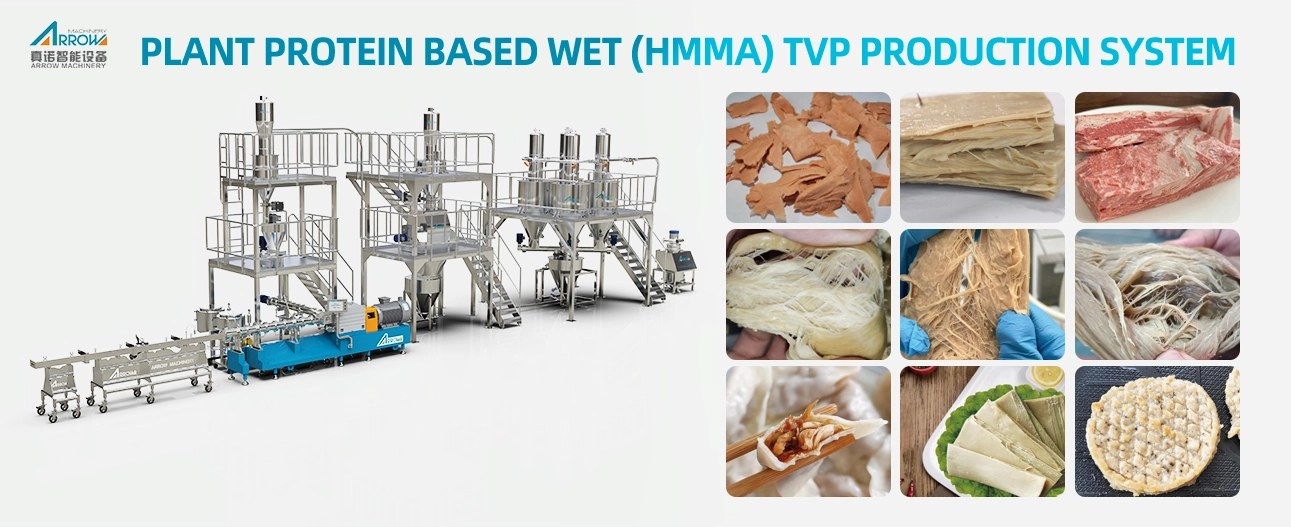
ARROW’s High Moisture Meat Analog Production Line combines twin-screw extrusion with continuous cooling-die technology for soy protein isolate, pea protein, and wheat gluten. The line is designed for high-moisture products in the 50%–70% range, while capacity varies with formulation, fiber density, and cooling-die dimensions.
Cooling Duty Rises With Commercial Throughput
When output increases, check product thickness, flow distribution, cooling area, cooling medium, heat removal, discharge temperature, and texture consistency across the section. There is no single cooling temperature for every HMMA product; duty depends on the material, geometry, residence conditions, and agreed quality limits.
Test the Cooling Die With the Target Product
A scale-up trial should inspect fiber direction, internal structure, edge-to-center consistency, dimensions, and continuous discharge stability. Compare beginning, middle, and later samples. If the center behaves differently from the edges, or texture changes as the die warms, address the cooling design or operating window before release.
What Changes When a Trial Becomes a Continuous Run?
Startup Conditions Are Not Stable Production
Separate startup, transition, stable operation, shutdown, and restart in the trial record. Early material may reflect filling, heating, liquid stabilization, or die conditions. Later material may reveal feed drift, motor-load drift, pressure change, moisture variation, texture change, or dimensional variation.
The procedure should define when the line is stable and what evidence is required before samples are accepted. This does not impose a universal number of hours; it defines a stable period that represents the planned production condition and normal transitions.
Use Stable Acceptable Product to Define Capacity
HMMA production capacity should be based on stable acceptable product, not a short-duration maximum. The line must maintain the approved moisture range, dimensions, texture, and handling condition at the required rate so the product can be chilled, frozen, packaged, and dispatched.
Can Downstream Handling Become the New Bottleneck?
Cutting and Transfer Must Match Extrusion Output
A high-moisture line is a production system, not only an extruder and die. Cutting speed, dimensions, transfer distance, deformation risk, and hygienic contact surfaces affect usable output. An undersized or poorly matched cutter may create die accumulation, while an unsuitable transfer route may deform soft product.
Cooling, Freezing, and Packaging Belong in Scale-Up
Chilling or freezing capacity, temporary holding, packaging, cold storage, and dispatch scheduling belong in the scale-up brief. If downstream temperature control cannot accept the commercial flow, the extruder may produce more material while the plant still cannot release more saleable product.
A plant-based meat production line should connect these steps so the approved process window can be maintained beyond forming.
How Should Hygiene and Cleaning Change at Commercial Scale?
More Continuous Production Creates More Sanitation Interfaces
Commercial-scale layouts can introduce product-contact surfaces and residue points. Review the extruder discharge, cooling section, cutting equipment, transfer conveyors, guards, drains, and access points as one hygienic route. Cleaning access and cross-contamination controls belong in layout and equipment design.
The sanitation program depends on the product, site, and applicable requirements. The engineering brief should still identify cleaning methods, changeover expectations, water and drainage provisions, and access points between batches. A line that makes a good sample but cannot be cleaned consistently may not support the product portfolio.
Changeover and Cleaning Time Affect Usable Capacity
If the factory will run multiple protein bases, flavors, or formats, capacity planning must include cleaning, restart, validation, and changeover time. Distinguish theoretical running time from time available for approved production.
What Should a Commercial Scale-Up Trial Prove?
Define Measurable Acceptance Criteria Before the Run
Acceptance criteria should be agreed before the trial. Depending on the product, they may include moisture, dimensions, fiber direction, texture, water retention, motor-load behavior, process stability, and continuous output. Define sampling methods, instruments, and how deviations will be handled.
Do not approve a run because the sample merely looks similar to the pilot product. The commercial trial must show that the line holds defined attributes within the agreed process window, using measurable or documented evaluation methods.
Sample Across Time, Not Only at One Moment
Collect samples at startup, after stable operation, and later in the planned run. Additional points may follow a changeover, adjustment, or restart. Time-based sampling helps reveal process drift, cooling imbalance, moisture movement, texture variation, and dimensional changes.
What Changes Between Factory Trial and Site Commissioning?
Factory Trials Validate the Process Basis
A factory acceptance test can confirm the formula basis, equipment configuration, process window, sample quality, and agreed capacity method under controlled conditions. The record should state the material, utilities, settings, sampling plan, and open items.
Site Commissioning Validates the Real Factory Environment
Site commissioning adds local power, water, cooling utilities, room conditions, operator practices, downstream cutting or freezing, cleaning procedures, and actual layout. FAT and site commissioning should be connected, but they are not the same acceptance event. The commissioning plan should also define the supplier’s service and commissioning support.
What Should Buyers Include in an HMMA Scale-Up Brief?

A supplier can assess commercial risk more accurately when the inquiry includes the full product and operating basis: target product, representative sample, protein ingredients, formula status, target moisture, dimensions, directional texture, output, trial data, workshop dimensions, utilities, cooling or chilled system, cutting and forming, freezing or packaging, cleaning expectations, and acceptance criteria. This same brief can be shared with ARROW MACHINERY or other qualified suppliers.
Identify what is fixed and what remains open. If the formula is approved but packaging is not, say so. If a second product has not completed trials, list it as a future option. This allows the proposal to separate the base line from optional modules.
Conclusion: Scale the Process Window, Not Only the Machine
HMMA scale-up is more likely to succeed when formula, material handling, extrusion, cooling, continuous operation, downstream transfer, hygiene, and cold-chain steps stay within a defined process window at commercial throughput. The question is whether the plant can release the approved product consistently.
To review your requirements, share the approved trial formula, target product, moisture range, trial records, output, cooling plan, downstream route, utilities, and acceptance criteria through your HMMA scale-up brief. These inputs help ARROW MACHINERY engineers review the line and identify tests required before release.
FAQs
Q: Can a successful HMMA pilot formula be copied directly to commercial production?
A: Not by default. Recheck the formula against commercial feed stability, liquid dosing, thermal and mechanical load, cooling performance, downstream handling, and continuous-run behavior. A pilot establishes a process basis; it does not automatically validate the commercial line.
Q: What should be checked when scaling an HMMA cooling die?
A: Review heat removal, flow distribution, thickness, edge-to-center consistency, discharge condition, fiber direction, and texture stability. Test the cooling die with the target formula and geometry.
Q: How long should an HMMA commercial trial run?
A: There is no universal number of hours. Run long enough to demonstrate stable operation under the planned condition, including startup, stable production, sampling, and normal transitions. Project criteria should define the evidence.


