



The belt dryer working principle is straightforward: a moving belt carries a controlled bed of food through heated-air zones, heat enters the product, and water moves from the product interior to its surface before the air carries that vapor away. The engineering challenge is that these events happen together. Air condition and distribution, bed loading and permeability, dryer residence time, exhaust, and product-specific drying behavior must work as one system.
That is why a food belt dryer cannot be selected from belt speed or a published capacity alone. A useful preliminary configuration starts with the water that must be removed, the product’s tolerance for heat and handling, and the time and airflow available to complete that duty. Representative trials then show whether the proposed settings produce an even, saleable result.
What a Food Belt Dryer Must Control
A continuous belt dryer has three linked control groups: the drying air, the product bed, and time. On the air side, temperature affects the energy available for evaporation, while humidity affects how much more vapor the air can accept. Air velocity and distribution determine whether that drying potential reaches the whole bed or bypasses part of it.
The product bed adds its own resistance. Piece size and shape, surface condition, bulk density, and the way pieces settle on the belt all affect permeability. A shallow, open bed may let air pass readily. A deeper or compacted bed can increase pressure drop and create less-exposed regions. The feed system therefore does more than deliver kilograms per hour: it establishes the bed through which the air must travel.
Time closes the loop. Belt speed and effective heated length determine how long the product remains in the dryer, but a longer stay is not automatically a better process. More exposure may help water move out of a dense product, yet unnecessary heat can damage texture, color, flavor, or structure. The practical target is the shortest operating window that reaches the required moisture and quality specification consistently, not the longest possible dwell.
These variables should be specified together. The FAO’s engineering guidance on crop drying relates the amount of water to be removed to the moisture-carrying capacity of the air when estimating dry-air demand and airflow. For a buyer, the implication is clear: define inlet and target moisture, product feed rate, product form, and allowable air conditions before discussing the dryer envelope.
How Air Moves Through the Product Bed
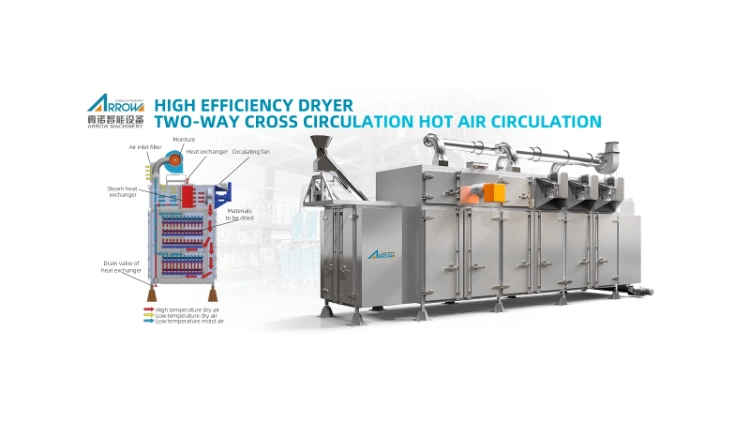
Belt dryer airflow begins upstream of the visible product bed. A fan and air-distribution system must deliver air to the belt with enough uniformity that the left, center, and right portions of the product see comparable conditions. Air then travels through or across the bed, takes up vapor, and moves toward an exhaust or recirculation path. A poor distribution pattern can leave some regions under-dried even when the average outlet reading looks acceptable.
The bed behaves as a porous layer. Air follows the paths of least resistance, so gaps, uneven spreading, edge leakage, or local compaction can redirect flow. Increasing total fan volume does not necessarily correct the pattern; it may increase flow through already open paths while the resistant areas still receive too little. This is why plenum design, baffles, belt loading, and feed distribution matter as much as the fan rating.
Direction also changes the contact between air and product. Top-down or bottom-up flow can be selected to suit the bed and the way product sits on the belt. Alternating direction between zones can expose different surfaces and reduce persistent wet areas. Cross-flow and side-air arrangements introduce other distribution choices. None is universally superior. The suitable arrangement depends on whether the product is granular, shaped, fragile, sticky, or prone to forming a tight layer.
A peer-reviewed review of airflow measurement in food cooling and drying identifies both flow rate and distribution as critical design factors and explains why measured airflow is used to validate models. Procurement should reflect that distinction. Ask how airflow uniformity will be checked across the working width, not only what total air volume the fan can provide.
Connect Moisture Load, Residence Time, and Belt Loading
Moisture load is the water-removal duty presented to the dryer. It depends on feed rate and the difference between inlet and target moisture, with both moisture values expressed on a consistent basis. The calculation should use the target saleable output rather than treating wet feed rate as finished capacity. Otherwise, a quotation can appear to meet the required throughput while delivering less dry product than the factory plan needs.
Dryer residence time is the period available for heat and mass transfer. Slowing the belt increases that period; increasing heated length can do the same without changing speed. Yet neither adjustment removes the need for suitable air. If the air reaches the product already humid, or if flow bypasses the bed, extra time may add heat without removing water at the required rate.
Belt loading links production rate to airflow resistance. More material per square meter raises the amount of water presented to each part of the belt and usually deepens the bed. The deeper layer can make air distribution more difficult at the same moment that the moisture-removal duty rises. Conversely, reducing the layer can improve exposure but may reduce saleable output unless belt width, speed, or operating hours change.
The buyer therefore has several trade-offs rather than one setting to optimize. A higher moisture load may call for more effective dry-air flow, more residence time, a lower loading, additional drying area, or a staged combination. A dense product may be limited by moisture movement inside each piece even after external airflow is adequate. The open-access review Conveyor Belt Crop Dryer Modelling describes this coupled heat-and-mass-transfer problem and the role of empirical validation. Its practical lesson is to use calculations to define a trial window, then use trial data to set the operating window.
Match Drying Zones, Exhaust, and Product Handling
Multiple zones allow the dryer to change air conditions as the product changes. Early in the process, abundant surface moisture may make water removal relatively responsive to air conditions. Later, water often has a longer path from the product interior to the surface, so simply applying the same conditions for longer may not be the best quality decision. Zone temperatures, air volume, humidity, and direction should follow the product’s drying curve rather than repeat one setting from inlet to outlet.
Exhaust and dehumidification must remove the vapor released in each zone. Recirculation can retain useful heat, but recirculated air also carries moisture. The system needs enough purge or dehumidification to prevent inlet air from becoming too humid for the required duty. Buyers should ask for the proposed fresh-air, recirculation, and exhaust logic together with the moisture balance; an isolated fan specification does not show whether vapor can leave the process.
Product handling protects the air design from avoidable variation. A level feeder supports consistent bed depth. Side containment reduces material loss and air leakage. A cleaning arrangement can help preserve belt openness when crumbs or coatings accumulate. Downstream cooling may be needed when product must reach stable conditions before coating, conveying, or packaging, but that requirement belongs in the line balance rather than being assumed for every application.
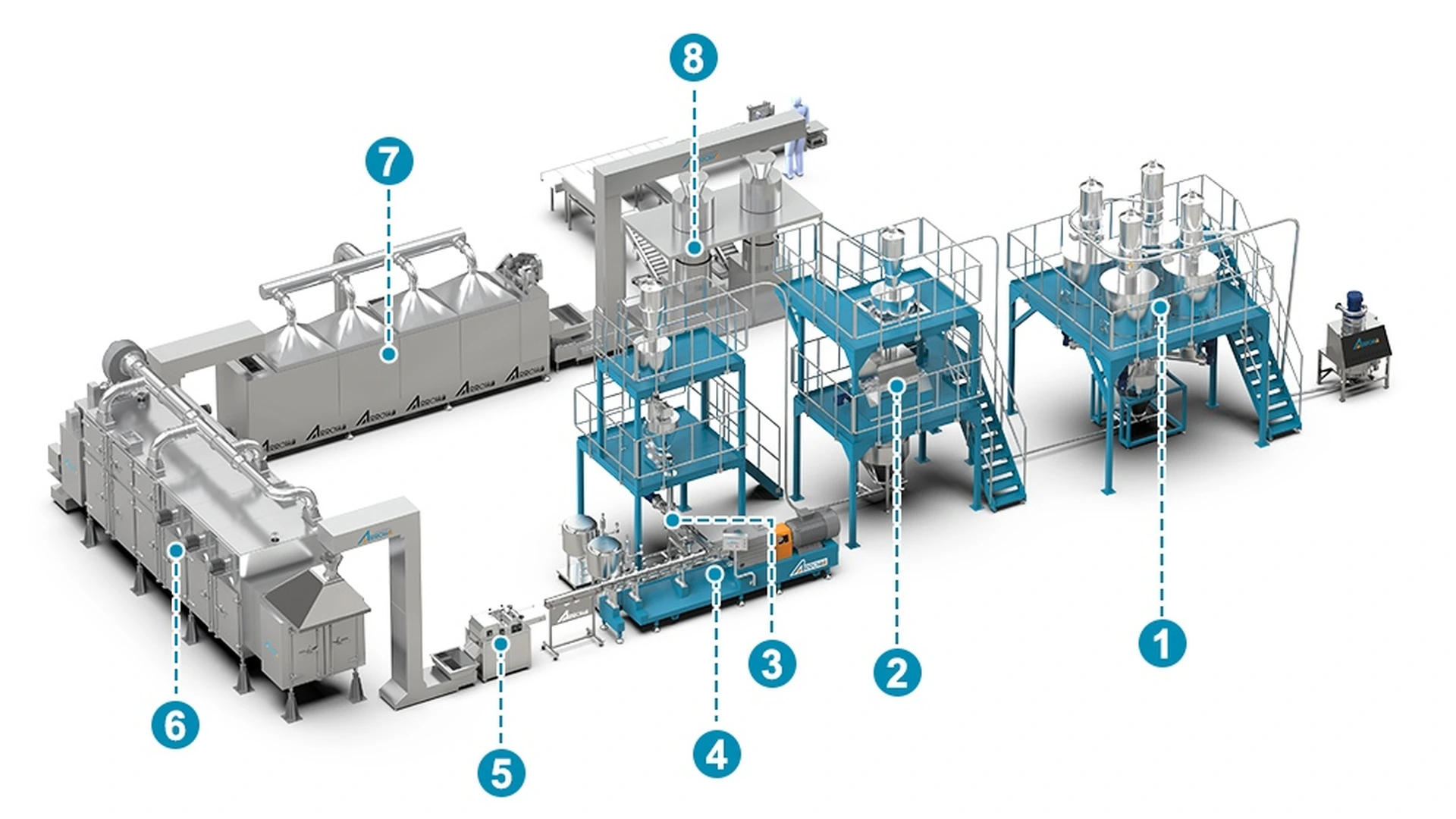
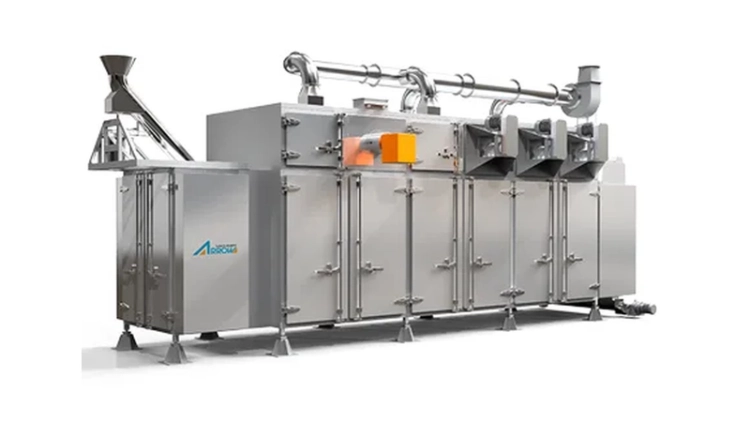
ARROW MACHINERY’s industrial food dryer conveys material through one or more heated sections with circulation and dehumidification. Its configuration can include top-down or bottom-up air passage and adjustment of air volume, temperature, residence time, and feed speed, with optional belt cleaning and product cooling. Cross circulation, side air delivery, and side baffles are further configuration tools. The wider belt dryer range should be treated as a set of possible starting points, not as proof that one arrangement fits every food.
Validate the Dryer With Representative Product Trials
Drying calculations narrow the design space, but a representative trial tests the assumptions that matter most. Product composition, piece size, expansion, density, porosity, surface coatings, and structural change can alter the rate at which internal water reaches the surface. Two products with the same inlet and target moisture can therefore need different residence times under the same nominal air conditions.
Define the trial before samples enter the dryer. Record the material and lot, pretreatment, inlet moisture and temperature, feed rate, spread pattern, bed depth, belt speed, zone settings, and exhaust condition. Sample across the belt width as well as along the process. Outlet moisture alone may hide a wet edge or a broad distribution that could create problems in storage or packaging.
Acceptance criteria should connect moisture to product quality and saleable output. Depending on the product, the trial may also track color, texture, breakage, shape retention, bulk density, or rehydration behavior. The relevant tests must come from the buyer’s specification; they should not be improvised from an unrelated application. Repeating the run at planned operating conditions also helps distinguish a stable window from a one-off result.
Use the findings to update the moisture balance, airflow plan, residence-time range, and line capacity. If the outlet is uneven, investigate feed distribution and airflow before automatically increasing temperature. If the center remains wet while the surface is dry, the limitation may lie inside the product rather than at the air interface. ARROW MACHINERY can use representative material and the buyer’s targets in a project-specific trial and configuration discussion. Provide the product form, inlet and outlet moisture targets, required saleable output, heating utility, available footprint, and downstream handling needs so the discussion begins with a complete process duty.
Conclusion
A belt dryer works only when the moisture load, air system, product bed, and available time are matched. Temperature supplies heat; air humidity and flow determine vapor-removal potential; bed depth and permeability determine whether that potential reaches the product; residence time gives internal moisture time to move. Exhaust, recirculation, feeding, cleaning, and cooling keep those conditions usable from inlet to outlet.
For procurement, start with the product and the required saleable result. Build a preliminary moisture and airflow balance, choose a zone and handling concept, and then validate the proposed operating window with representative trials. That sequence produces a more useful dryer specification than a capacity number alone and gives the supplier clear inputs for a configuration discussion.
FAQ
Q:How does a food belt dryer work?
A:A moving belt carries a controlled layer of food through heated-air zones. Heat supports evaporation, moisture moves from the product interior to the surface, and the air takes the vapor toward an exhaust or dehumidification path. Belt speed, airflow, air condition, and bed loading are adjusted together to reach the required outlet condition.
Q:Which inputs are needed to estimate belt dryer capacity?
A:Provide wet feed rate, required saleable output, consistent-basis inlet and target moisture, product dimensions and bulk behavior, expected bed depth, allowable temperature range, utility conditions, operating hours, available footprint, and downstream cooling or handling needs. Product drying-curve or trial data is needed to convert those inputs into a defensible residence-time and area estimate.
Q:Why can two products require different residence times in the same dryer?
A;Their internal moisture movement may differ because of composition, density, piece size, porosity, expansion, coatings, or structural changes during drying. Once surface water is removed, the slow step may be movement from the center of each piece. Representative trials reveal that product-specific limitation and prevent one product’s setting from being applied blindly to another.


