



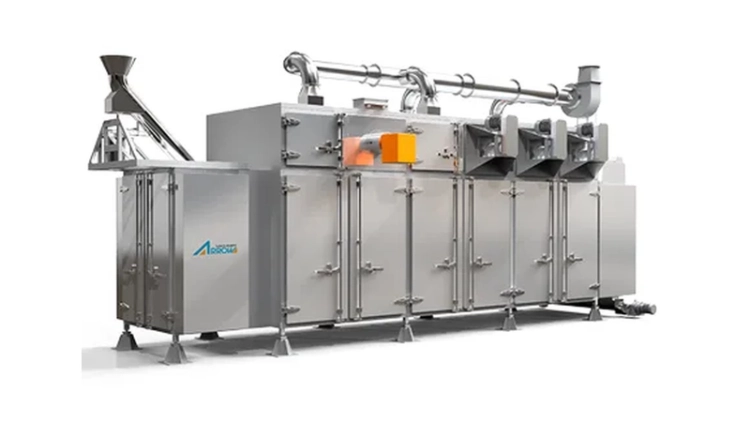
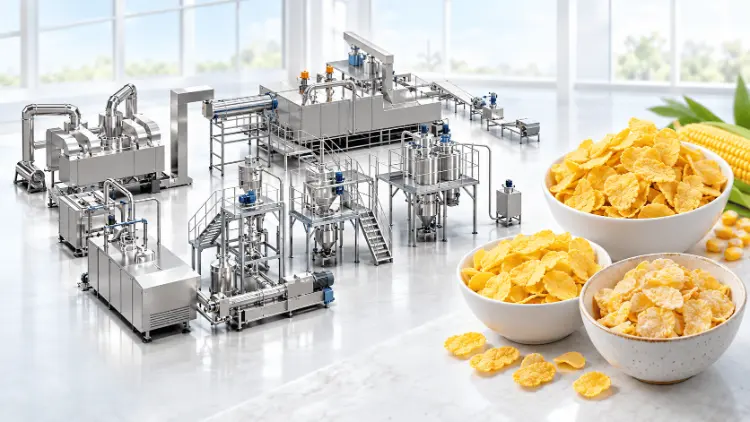
A corn flakes line can include an extruder rated for a high hourly output and still fall short of the factory’s expected packed production. This is because corn flakes are not finished when they leave the extruder. The material still has to pass through pre-drying, flaking, toasting, coating where required, final drying, cooling, and packaging. Each stage receives a product with a different moisture level, thickness, temperature, and handling requirement.
For buyers planning a corn flakes line configuration, the useful question is therefore not which machine has the largest nameplate capacity. It is whether every machine can receive the upstream product in the right condition and pass it forward without creating a bottleneck or damaging the flake. Capacity should be defined at the point where acceptable, saleable corn flakes reach packaging.
Start With the Finished Flake and Saleable Output
Equipment balance is easier to judge when the finished product is defined first. Thin plain flakes can create a different process load from thicker coated flakes, so the project team should define what the line is expected to sell before comparing machines.
Define the Product Before Defining Hourly Capacity
The specification should cover target flake thickness, approximate piece size, acceptable breakage, color, texture, coating level, final moisture, and packing condition. Raw-material composition also belongs in the same brief because corn-based formulas, multigrain blends, and other cereal formulations can behave differently during extrusion, pre-drying, flaking, and heat treatment.
These details affect corn flakes production equipment differently. Tighter thickness control increases flaker demands, while heavier coating adds downstream mass and moisture. Equipment should therefore be selected against the product specification, not a generic “500 kg/h corn flakes” description.
Separate Intermediate Throughput From Finished Output
Several capacity numbers can exist on the same line. The extruder produces an intermediate piece. The pre-dryer changes its condition before flaking. The flaker converts it into flakes. Toasting changes moisture, color, and texture. Coating adds material, and the final dryer and cooler prepare the product for packing.
Each stage needs its own capacity basis. The commercially useful figure is stable saleable output at the agreed specification, not wet feed rate or a short-duration machine peak.
Balance Extrusion, Pre-Drying, Flaking and Toasting
The extruder and flaker should not be treated as independent machines. The extruder establishes the material that the pre-dryer and flaker must handle, while the flaker depends on a stable intermediate condition to produce consistent thickness and shape.
Treat Extruder Discharge as an Intermediate Product
A twin screw extruder provides mixing, cooking, conveying, and forming functions, but its discharge in a corn flakes process is still an intermediate material. Size consistency, density, moisture, temperature, and feed stability all affect what happens next. The extruder should therefore be evaluated together with the pre-drying and flaking stages rather than only by motor size or nominal output.
If higher output reduces product uniformity, the flaker may show unstable thickness, sticking, uneven loading, or more breakage. Extrusion output is useful only when downstream equipment can process it continuously.
Use Pre-Drying to Prepare a Repeatable Flaker Feed
Pre-drying is not simply a smaller version of the final dryer. Its role is to move the extruded intermediate toward a condition that can be flaked consistently. The required target depends on the formula, throughput, equipment setup, and desired flake.
During trials, buyers should examine feed uniformity, roller behavior, sticking, breakage, and thickness consistency together. Do not assume one moisture target for every formula; use the condition that supports stable flaking and the agreed product specification.
Once extrusion and pre-drying are stable, the next capacity constraint can move to the mechanical forming and thermal treatment stages. This is where the line may require more detailed balancing than a list of machine capacities alone can show.
Check Flaker Capacity at the Required Thickness
Flaker output depends on more than roller width. Feed distribution, roller gap, roller speed, product condition, target thickness, and acceptable breakage all influence usable throughput. Increasing speed does not automatically increase saleable production if thickness variation or product damage also rises.
Test the flaker at the required product specification. Compare acceptable flakes leaving the machine, not only intermediate material entering it, especially when one line must make several flake formats.
Match Toaster Duty to the Incoming Flake
The toaster must handle the actual flake produced upstream. Thickness, incoming moisture, loading, required residence time, desired color, and texture target all affect thermal duty. A toaster selected only from extruder output can be poorly matched if upstream conditions change the amount of heat treatment required.
Commission flaker and toaster settings as one operating window. The target is a stable combination that maintains thickness, color, texture, and integrity at the required continuous output.
Balance Coating, Final Drying and Cooling
A balanced line does not end at toasting. In the Corn Flakes Production Line, the process continues through coating and final drying and cooling. These stages can change actual plant output, especially when the factory plans both plain and coated products. The current line flow also separates extrusion, pre-drying, flaking, toasting, coating, and final Drying & Cooling as distinct process duties rather than one combined capacity figure.
Coating Adds Another Process Load
Syrup, sugar, honey, maltose, cocoa, or other finishing materials change the mass and surface condition of the product. The coating system must apply the required amount consistently without creating a downstream load that the dryer cannot remove.
Do not assign coated and uncoated products the same final capacity by default. A heavier coating can change residence time, drying duty, handling, and cleaning, so each important formulation should be reviewed separately.
Final Drying and Cooling Establish the Packing Condition
The final dryer must remove required moisture while protecting flake integrity, and cooling must prepare the product for conveying and packaging. Assess this section by moisture removal, airflow, residence time, bed loading, and product quality rather than one kg/h figure.
Factories considering several cereal formats can also review the broader breakfast cereal production system when planning shared upstream or downstream equipment. The important point is to keep the corn flakes duty clearly defined instead of assuming every cereal places the same load on the line. Other cereal formats can use different shaping and thermal duties, so downstream requirements should be treated as product-specific.
Find the Real Bottleneck With a Stage-by-Stage Capacity Map
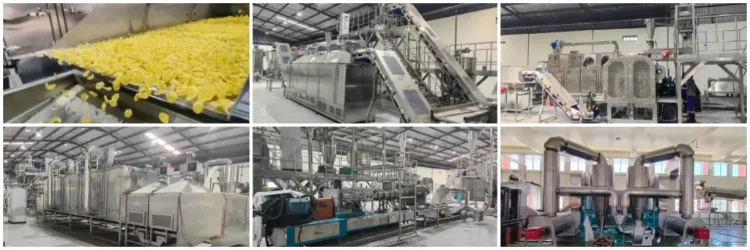
A practical corn flakes line configuration should show how capacity changes from one stage to the next. The map does not need to predict every operating loss in advance. It should make the basis of each quoted capacity visible and identify where testing is still required.
|
Stage |
Capacity basis |
What buyers should verify |
|
Extruding |
Stable intermediate output |
Formula, feed stability, product condition |
|
Pre-Drying |
Conditioned flaker feed |
Moisture distribution and uniformity |
|
Roller Flaking |
Acceptable flakes |
Thickness, sticking, breakage |
|
Toasting |
Toasted output |
Color, texture, integrity |
|
Coating |
Finished recipe load |
Application consistency and cleanability |
|
Drying & Cooling |
Saleable product |
Final moisture, temperature, packing condition |
This reveals whether a larger upstream machine creates useful output or may simply shift a bottleneck downstream, giving buyers a stronger basis for supplier comparison.
Short stops and changeovers also matter. Roller adjustments, coating changes, cleaning, and SKU transitions reduce usable production time, so stable recovery can matter as much as peak throughput.
Validate Balance With Trials and FAT
Equipment calculations establish a design basis, but trials should confirm how the complete line behaves with the intended material and product specification. A useful factory acceptance test should follow material through the connected process rather than demonstrate individual machines in isolation.
Record the raw-material batch, extrusion output, pre-dryer condition, flake thickness, breakage, toaster conditions, coating application, final moisture, and stable finished output. Define the required stable operating period before the result is accepted.
The finished product should drive acceptance. Reaching a nominal hourly figure with excessive breakage, unstable thickness, uneven color, or unacceptable moisture is not the same as stable saleable production. For broader project planning, ARROW MACHINERY can connect equipment selection with line layout and whole-plant project planning while the buyer retains its own product specifications and acceptance criteria. The company’s current engineering scope includes complete food-project solutions and plant planning around production requirements.
Build the Inquiry Around Interfaces, Not Machine Count
A useful inquiry should give every supplier the same product and operating basis. Include raw materials and representative samples, target flake thickness, coating plan, required saleable output, operating hours, SKU range, packaging method, utilities, available floor area, and expected future expansion.
Ask suppliers to identify the capacity basis at each major stage, the expected handoff conditions, and assumptions that still require trials. This makes a corn flakes machine line easier to compare by function rather than machine count.
The quotation should also distinguish supplied equipment from site utilities, installation work, packaging interfaces, and other factory-side requirements. For multiple cereal products, identify which sections are shared and which need product-specific settings or modules.
A balanced corn flakes production line starts with the finished flake and works backward through every handoff. Extrusion, pre-drying, flaking, toasting, coating, final drying, and cooling must support the same saleable output target.
Share the target flake, raw materials, coating plan, required output, operating schedule, utilities, and workshop conditions by sending your corn flakes line brief. A project discussion can then focus on the interfaces most likely to limit stable production instead of simply increasing the size of one machine.
FAQs
Q: Can a larger extruder increase corn flakes line output?
A: It can increase upstream capacity only if the pre-dryer, flaker, toaster, coating system, final dryer, cooler, and packaging section can handle the resulting product at the required quality. The complete line should be balanced around stable saleable output.
Q: Why is pre-drying needed before flaking?
A: Pre-drying helps establish a more suitable and repeatable condition for mechanical flaking. The target should be validated with the actual formula, throughput, flaker setup, and finished flake specification rather than taken from a universal moisture value.
Q: Which machine usually limits corn flakes production capacity?
A: There is no fixed answer. The bottleneck can move between extrusion, pre-drying, flaking, toasting, coating, final drying, cooling, or packing depending on the product and operating conditions. A stage-by-stage capacity map and full-line trial provide a more reliable answer.


