



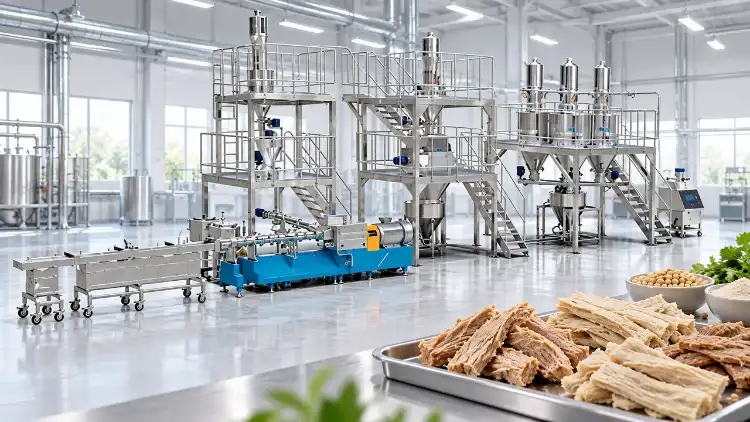

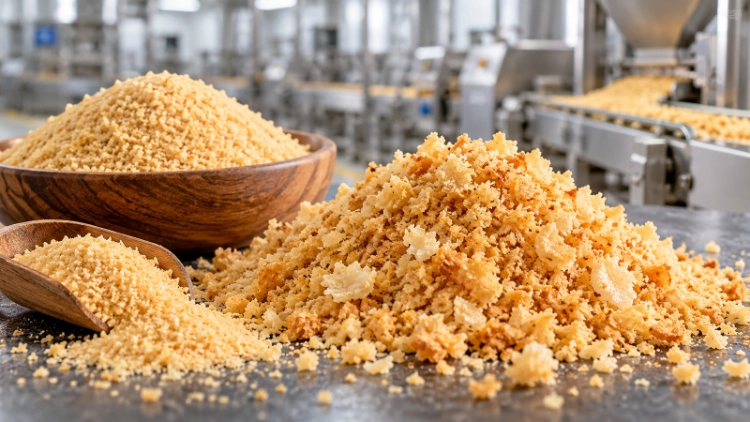
Reliable bread crumb particle size control takes more than choosing a grinder screen. Extrusion structure, traction cutting, crushing load, and downstream handling all affect the final mix of usable crumbs, oversize pieces, and fines. Screening cannot correct every upstream cause of variation.
The target is a repeatable particle-size distribution at the required saleable output. Producers need an agreed finished specification, measurements beyond average size, and evidence of where the distribution drifts during continuous production.
Define Particle Size by the Finished Coating Application
Bread crumbs for fried chicken, seafood, or prepared foods may require different shapes and coverage. Coarse, open crumbs behave differently from fine granular ones; even pieces passing the same sieve opening may differ in shape and coating performance.
Start with a finished-product specification that describes the target size band, acceptable oversize material, fines limit, moisture condition, and shape. The buyer should also decide how these will be measured. A single average diameter can hide a batch containing both large fragments and excessive powder. A sieve analysis, supported by a visual shape reference where needed, gives the production team a more useful picture.
Evaluate particle size alongside coating coverage, adhesion, appearance after frying or baking, and excessive fines. Final limits must reflect the customer’s food application, not a universal breadcrumb mesh size.
The distinction between panko and regular bread crumbs can help clarify why appearance and coating behavior matter alongside nominal particle size. For an extruded line, those requirements must carry through to the process controls.
Look for Variation Before the Grinding Machine
In an extrusion-based bread crumb line that includes traction cutting and crushing, the grinder receives an intermediate material whose structure and dimensions have already been shaped upstream. When that feed changes, a constant grinder setting may still produce different results.
Keep the Extruded Structure Consistent
Raw-material properties, ingredient ratios, water addition, feed stability, and cooking conditions can affect expansion and how readily the intermediate product fractures. A more open structure may break differently from a denser piece. The response depends on the recipe and actual processing conditions; it should be established during representative trials rather than assumed from one machine setting.
Compare the intermediate material at the same point in the process across several runs. Check dimensions, visible internal structure, moisture, and whether the piece breaks cleanly or crumbles excessively. If these characteristics are drifting before the grinder, repeatedly changing its screen will address only part of the problem.
Control Traction and Cutting Before Crushing
Traction and cutting determine what enters the crusher. Uneven lengths or damaged pieces can change how material is presented to the grinding zone. Inspect cutter condition, feed alignment, and the consistency of intermediate dimensions, particularly after a product changeover.
Sample before crushing as well as at final screening. This helps separate unstable feed from size-reduction problems.
Set Crushing Conditions Around the Required Crumb
The crusher is the main size-reduction stage, but grinding intensity and screen selection need to be considered together. Excessive breakage may increase fines; insufficient size reduction may leave too much oversize material. The correct balance depends on the required shape and distribution.
Check Feed Rate, Wear, and Screen Condition
Crusher loading should remain reasonably steady. Surges can change the interaction between incoming pieces and the crushing mechanism, while worn or damaged working parts may affect the resulting size distribution. Maintenance checks should include the condition and fit of the relevant cutting or crushing elements and the installed screen.
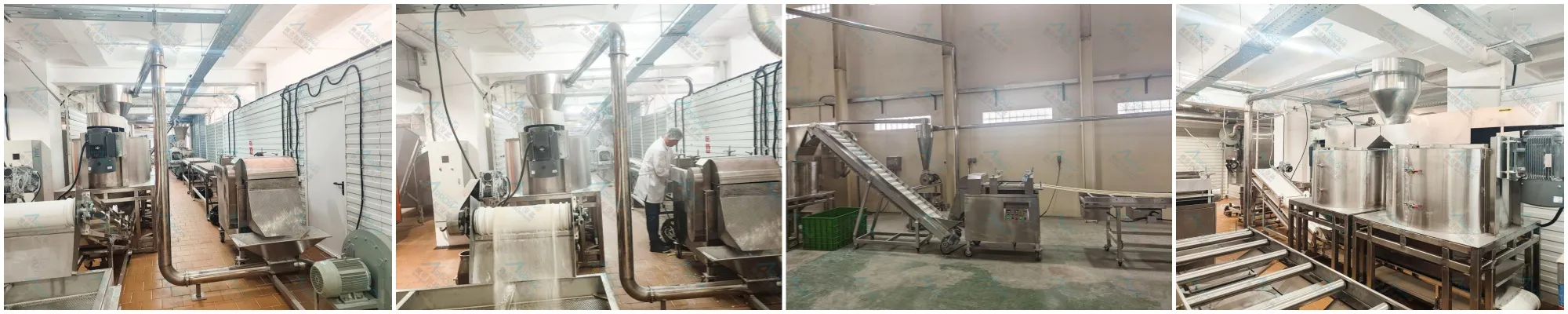
The extruded bread crumb production line connects mixing, Extruding, Pulling Cutting, crushing, drying, cooling, and screening. Its equipment scope includes a grinding machine and a vibrating fluidized-bed dryer. Different screen openings can support different crumb formats, but the required result still needs confirmation with the customer’s material and target product.
A Screen Opening Is Not a Particle-Size Guarantee
A screen opening sets a physical passage condition; it does not mean every passing crumb has the same length, thickness, or mass. Irregular and needle-like pieces can orient differently as they pass. Their measured size also depends on the test method.
A different screen may shift coarse and fine fractions without removing fines already created in the crusher. Compare the full distribution against the specification; reducing oversize material at the expense of more powder may not improve yield.
Check What Happens During Drying, Cooling, and Transfer
Particle-size control continues after grinding. A crumb that meets the target immediately after crushing can fracture during drying, cooling, conveying, or packing. This distinction matters because changing the crusher cannot reverse damage that occurs later.
Drying conditions should suit the product’s initial moisture, shape, and fragility. Air movement and residence time need to remove the required moisture without unnecessary physical stress. The drying window depends on the formulation; no temperature or residence time suits every crumb.
Transfer points deserve attention as well. Excessive drop height, abrupt direction changes, equipment vibration, or rough handling may add small fragments. Cooling and conveying should prepare the material for screening and packing while limiting avoidable collisions.
When fines rise, sample both before and after drying. A sharp change between those points suggests a downstream handling or product-strength issue. If the fines fraction was already high before drying, investigate extrusion, cutting, and crushing first. These comparisons are more informative than increasing dryer temperature or replacing the grinder screen without evidence.
Use Screening Data to Diagnose Particle-Size Drift
Final screening can classify material and reveal whether production is holding the agreed size distribution. It is a measurement and separation step, not a cure for unstable extrusion or crushing. Record the fraction within specification along with oversized material and fines, using a consistent sampling and test method.
For a sieve test, keep sample mass, sieve arrangement, shaking method, and test duration consistent. Record the mass retained in each size band and compare it with the total sample, rather than judging appearance alone. Elongated crumbs may also need a documented visual shape check. Otherwise, differences in testing technique can look like changes in the production process.
|
Observed result |
Possible cause to investigate |
First check |
|
Excessive fines after crushing |
Feed fragility or aggressive size reduction |
Intermediate structure, crusher loading, screen |
|
Too many oversized pieces |
Incomplete reduction or screen condition |
Feed dimensions, working parts, screen fit |
|
Wide variation between batches |
Raw-material or process drift |
Formula, moisture, extrusion, cutting |
|
Fines increase after drying |
Secondary breakage |
Drying conditions and transfer points |
|
Good average size but poor coating |
Unsuitable shape or mixed fractions |
Full sieve distribution and application trial |
Startup samples can miss later drift. Sample during stable operation and label material lot, time, machine settings, and sampling point for traceability.
Also define what happens to material outside specification. Oversize pieces may be evaluated for further processing, while excess fines may require segregation. Neither automatic recycling nor a particular recovery rate should be assumed unless that handling is included in the chosen line configuration and has been tested.
Prove Consistency During a Representative Production Trial
A production trial should demonstrate consistent particle-size distribution and finished moisture at the planned output, not merely one attractive sample. Those results are more meaningful than nominal capacity alone.
Before the test, agree on the raw material, target crumb shape, particle-size bands, fines limit, sampling frequency, and acceptable saleable output. Record the extrusion and cutting conditions, crusher settings, installed screen, drying conditions, and final screening results. Repeat measurements across the run so the team can distinguish a stable operating window from a brief favorable period.
A practical acceptance review can compare the following questions: Did the particle distribution stay within the agreed limits? Were moisture and coating performance acceptable? Did fines remain manageable after drying and transfer? Could the line hold the required rate without frequent intervention? Was the outcome repeatable with the representative ingredient batch?
For project-specific production trials, ARROW MACHINERY can review equipment configuration, process requirements, and testing conditions using representative raw materials. The exact trial method and acceptance criteria should still be agreed for the specific production line rather than inferred from a standard equipment description.
For commissioning, it also helps to assign responsibility for sample collection, screen changes, equipment checks, and operator training. These are practical handover points that can be discussed within the supplier’s technical service and training scope, subject to the project agreement.
Conclusion: Control the Distribution Across the Whole Line
Keeping extruded bread crumb size consistent requires stable intermediate material, controlled cutting and crushing, suitable drying and handling, and screening that measures the full distribution. A final sieve alone cannot compensate for an unstable process. A useful purchasing specification links acceptable crumbs and fines to a repeatable production rate and a documented trial method.
Review Your Bread Crumb Production Requirements
Prepare the target crumb shape, particle-size range, raw materials, acceptable fines level, expected output, and any application samples. Then share your breadcrumb production brief to discuss which crushing, drying, and screening conditions should be evaluated before the line configuration is finalized.
FAQs
Q: Can changing the crusher screen make bread crumb particle size more consistent?
A: A different screen can change the size fractions passing through the grinder, but it cannot correct variable extrusion structure, unstable cutting, or breakage after crushing. Compare the complete sieve distribution before and after the change, including fines and oversized pieces, to decide whether the adjustment improves usable output.
Q: Why do extruded bread crumbs develop excessive fines after drying?
A: Some fines may already be present after crushing. Additional fines can result from fragile crumb structure or mechanical stress during drying, cooling, and transfer. Compare samples before and after drying, then investigate where the increase occurs instead of assuming that the dryer temperature is the sole cause.
Q: How should a factory verify particle-size consistency during production?
A: Define the target size bands, permitted fines and oversize fractions, and a repeatable sieve test. Collect samples at agreed intervals during stable production, record machine conditions, and compare the results with moisture, coating performance, and saleable output. One approved sample is not enough to establish continuous consistency.


