



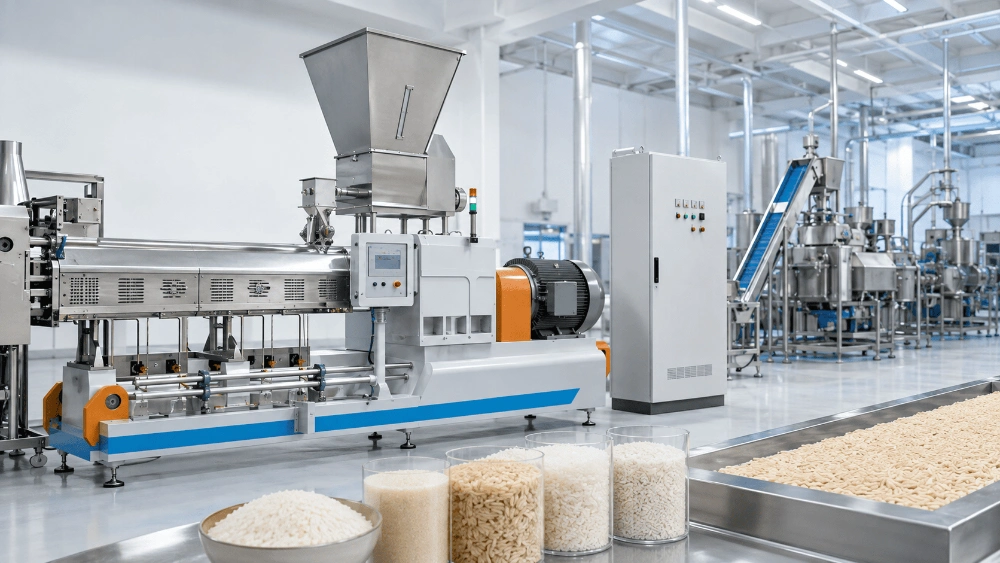

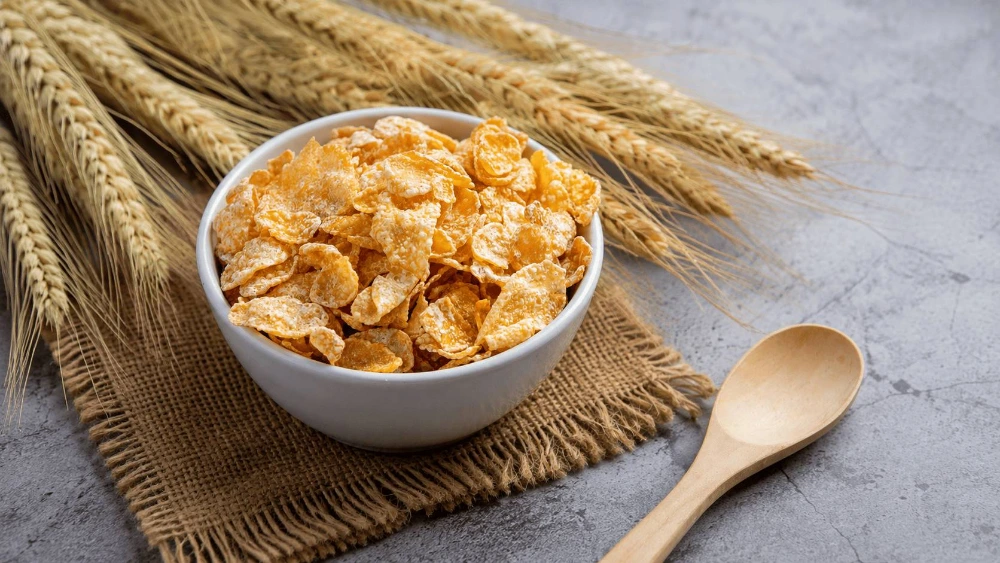
Breakfast cereal projects can start with similar ingredients and still require very different production lines. The decisive question is not simply whether extrusion is used. It is what should happen immediately after extrusion: should the product leave the die close to its final shape, or should the extrudate be conditioned and mechanically flattened into a flake?
That choice changes the downstream machines, moisture-control strategy, texture-development route, floor layout, operating workload, and commissioning plan. A buyer comparing an extruded flake production line with a directly expanded breakfast cereal production line should therefore define the finished product first and use that definition to work backward through the process.
Begin With the Finished Cereal, Not the Extruder
Directly expanded cereals develop much of their shape as material exits the die. Die geometry, cutting, formulation, moisture, temperature, pressure, and screw configuration are evaluated together during product trials because the operating combination needed for the intended expansion and shape is project-specific. The downstream line then stabilizes, coats, dries, cools, and packs those pieces.
Extruded flakes take a different route. Extrusion prepares and cooks the material, but the final flat form is produced by a flaking operation after suitable conditioning. The suitable moisture and mechanical condition at the flaker must be established with the intended formula and equipment during trials, using sticking, tearing, breakage, and thickness consistency as observations. Toasting conditions should likewise be set against the required texture, color, and eating quality rather than assumed from a generic recipe.
This distinction is the foundation of line selection. A factory that has not fixed the target shape, thickness, density, bite, coating level, and serving method is not ready to compare quotations.
Compare the Two Process Routes
The following comparison shows why the two cereal families cannot be treated as one interchangeable line configuration.
|
Decision point |
Extruded flakes |
Directly expanded cereals |
|
Shape formation |
Extrusion creates a conditioned piece that is later flattened |
Expansion and die cutting create a near-final shape |
|
Key downstream stage |
Flaking followed by toasting |
Drying and stabilization after direct expansion |
|
Moisture sensitivity |
Pre-flaking condition is a route-specific trial control point |
Die-exit behavior and subsequent drying are route-specific trial control points |
|
Typical shape control |
Flaker gap, feed consistency, pre-drying, and toast conditions |
Die design, cutter settings, expansion behavior, and drying |
|
Main line implication |
Requires dedicated flaking and toasting equipment |
Avoids the flaker and may use a shorter forming route |
|
Commissioning focus |
Thickness, breakage, blistering, color, and crispness |
Expansion ratio, shape definition, density, surface, and crispness |
The Extruded Flake Route
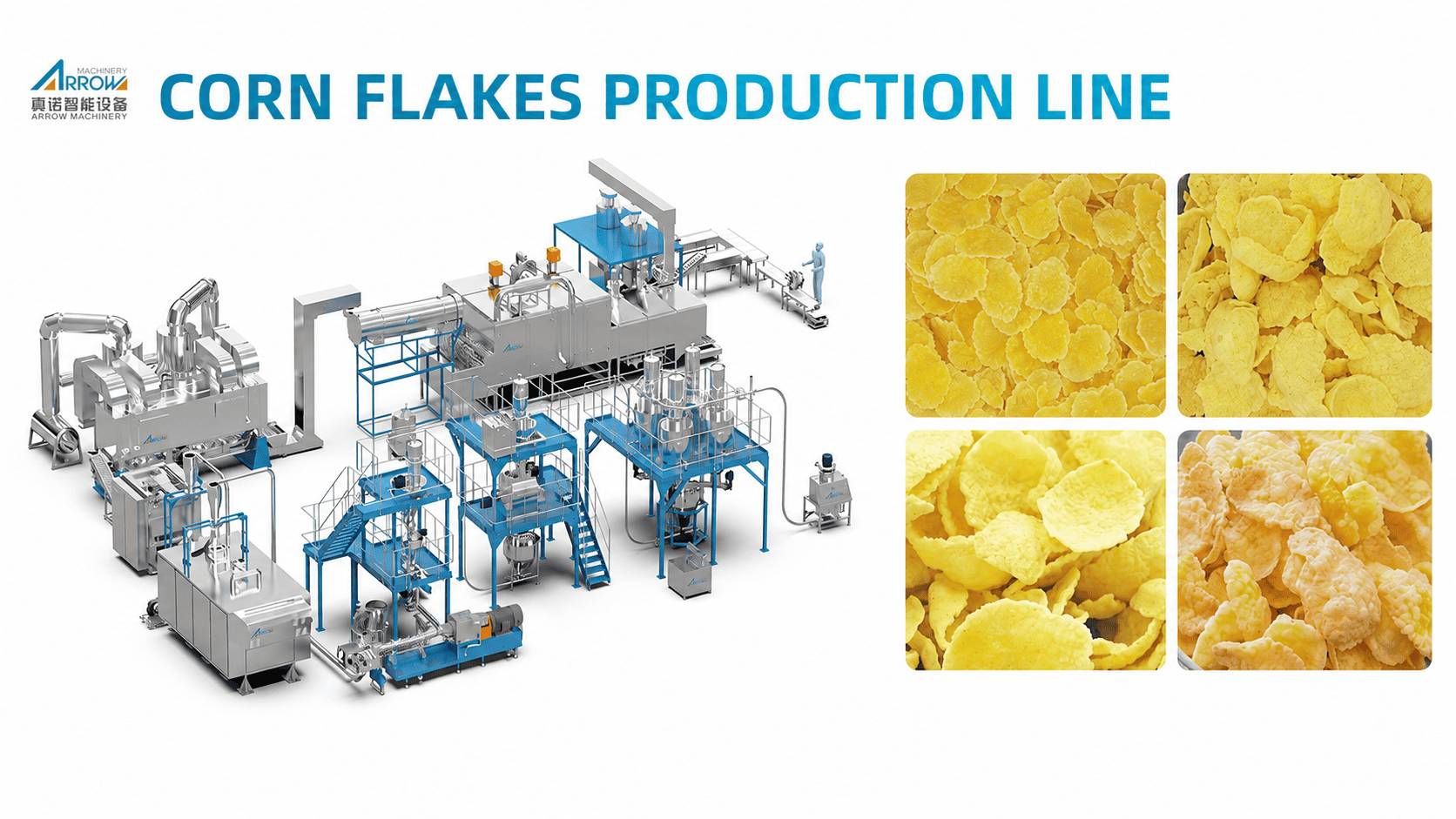
A typical corn flakes production route includes weighing and mixing, extruding, pre-drying, flaking, toasting, coating, and drying and cooling. Pre-drying is part of preparing the extrudate for flaking, but its operating target should be established during trials for the selected formula, throughput, and flaker.
The flaker introduces a mechanical forming stage used to control thickness and surface character. During trials, feed condition, roller behavior, flake consistency, sticking, and breakage should be checked together rather than linked to a single assumed cause. Flaker and toaster settings should then be commissioned as a connected system against the agreed thickness, texture, color, and integrity targets.
The Directly Expanded Route
For directly expanded breakfast cereals, the extruder, die, and cutter carry more of the shape-forming responsibility. The product may emerge as rings, balls, stars, shells, or other forms, subject to the selected die, formula, and trial results. Drying and cooling settings should be validated with the target product for moisture, shape integrity, and internal condition.
This route can remove the dedicated flaking stage, but it does not remove the need for process control. Raw-material properties, water addition, thermal input, screw configuration, die restriction, and cutting speed should be treated as interacting trial variables when qualifying expansion and bulk density. The line should be tested using the buyer’s intended raw materials and product targets rather than a generic cereal formula.
Equipment Decisions That Change With the Route
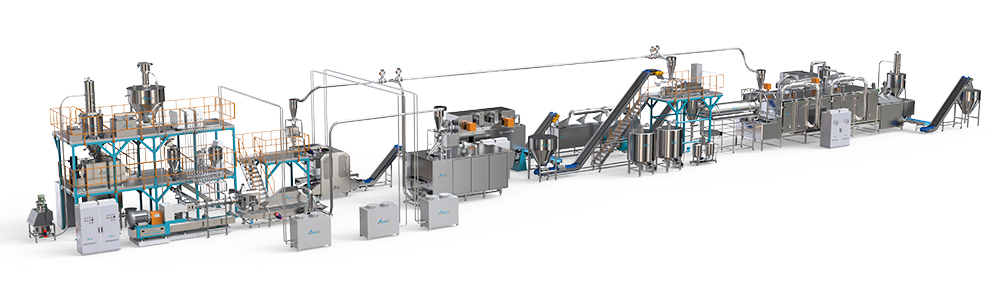
The same extrusion platform may support more than one cereal concept, but downstream equipment and operating windows are route-specific. Buyers should compare equipment by function and interface, not by machine count alone.
Raw-Material Handling and Mixing
Both routes need consistent weighing and mixing. The project brief should identify grain or flour base, particle size, incoming moisture, minor ingredients, liquid additions, batch size, and required throughput. Trial records should capture these inputs so any change in expansion, density, drying behavior, color, or texture can be assessed against the actual batch conditions.
For multi-ingredient formulas, storage and batching should deliver repeatable proportions to the mixer. Feed uniformity should be included in trial and commissioning checks alongside expansion, color, and texture, even when nominal extruder settings remain unchanged.
Extrusion, Die, and Cutting
Twin-screw extrusion provides controlled mixing, cooking, shearing, and conveying. The required screw configuration and operating window depend on the formula and product. Directly expanded cereal projects place particular emphasis on die geometry and cutting because these components define the emerging shape. Flake projects place more emphasis on producing a consistent intermediate piece that can pass through pre-drying and flaking.
Buyers should ask how dies are changed, how cutters are adjusted, which wear parts are included, and what product range has been tested on the proposed configuration. Flexibility is useful only when changeovers can be completed reliably and the downstream machines can handle the resulting products.
Flaking, Toasting, Drying, and Coating
An ARROW MACHINERY corn flakes production line includes dedicated flaking and toasting stages. Their capacity must match extrusion output under real operating conditions. A high nominal extruder rate has limited value if the flaker, toaster, coating system, or final dryer becomes the bottleneck.
Directly expanded products move from shaping into stabilization and downstream finishing. Depending on the formula and coating system, the route may use drying and cooling before coating, additional drying and cooling after coating, or no coating stage. Validate each configured dryer at the intended bed depth, residence time, airflow setting, and moisture target while checking product integrity. Test coated and uncoated capacity separately because the final duty is formula- and application-dependent.
Match the Route to the Product and Market
Neither route is universally better. The practical choice depends on what the factory intends to sell and how broadly it wants to diversify.
Choose an extruded flake route when the target portfolio depends on a flat cereal format, controlled flake thickness, toasted character, and products such as corn flakes or multigrain flakes. The additional machines and controls are justified when the flake itself is central to the product identity.
Choose a directly expanded route when the portfolio depends on shaped pieces, varied dies, lighter structures, or frequent visual changes. The route can support a broad shape family, but each proposed product should be qualified with a compatible formula, die, cutting setup, and trial-confirmed drying window.
For a factory planning both categories, the question becomes whether to build one highly flexible line, two specialized lines, or a shared upstream section with route-specific downstream modules. That decision should be tested against annual volume by product, changeover frequency, cleaning time, operator skill, available floor space, and the cost of production interruptions.
Prepare a Useful Line Inquiry
A strong equipment inquiry gives the supplier enough information to evaluate the full process rather than quote an isolated machine. Include:
– target products, shapes, dimensions, thickness, and bulk density;
– raw-material names, specifications, and representative samples;
– coated and uncoated product requirements;
– expected hourly output and annual operating schedule;
– target final moisture and packaging format;
– available electricity, steam, water, compressed air, and fuel;
– building dimensions, access limits, and preferred line direction;
– required market certifications and acceptance tests;
– changeover expectations and planned future products.
ARROW MACHINERY develops extrusion-based food production systems and supports process testing through its application resources. Buyers comparing cereal routes can review the breakfast cereals production line together with the corn flakes route, then submit samples and product targets before finalizing equipment configuration.
Turn the Comparison Into a Project Decision
The useful comparison is not “flakes or expanded cereals” in the abstract. It is whether the proposed process can repeatedly produce the required shape, texture, moisture, coating, and capacity with the factory’s actual materials and utilities.
Start with the finished product. Map the stages that create its form and texture. Balance every downstream machine against the extrusion rate. Then define trials and acceptance criteria around measurable outputs. This approach makes quotations easier to compare and reduces the risk of purchasing a line whose individual machines look suitable but do not work as a coordinated process.
FAQ
Q: Can one extrusion line make both corn flakes and directly expanded cereals?
A: Treat a shared extrusion platform as feasible only after trials with both target products confirm the required upstream configuration and downstream modules. Ask the supplier for a route-by-route configuration matrix and accept the shared-line option only if changeover steps, cleaning access, and acceptance criteria fit the planned production schedule.
Q: Why is pre-drying used before flaking?
A: It is used to prepare the extrudate for the flaking stage, but there is no universal endpoint for every formula. Set the operating target during a continuous trial and approve it only when roller feeding, flake thickness, product integrity, and sticking remain within the buyer’s agreed acceptance criteria.
Q: Which route offers more product shapes?
A: Direct expansion is the first route to evaluate when shape variety is the priority, but a die catalogue alone is not enough to approve a product. Qualify each proposed shape only after the intended formula produces acceptable geometry and the pieces remain within specification through drying, optional coating, cooling, and packing trials.
Q: What information is needed before requesting a cereal production line quotation?
A: Submit the target products and shapes, raw materials and formula status, required capacity, coated or uncoated finish, packaging, utilities, plant constraints, market certifications, and changeover expectations. Ask each supplier to tie its process flow, equipment scope, capacity, and acceptance conditions to those same inputs.


