





Corn flakes breakage is rarely caused by one machine. In most factories, it comes from several small problems across mixing, extrusion, flaking, drying, toasting, cooling, coating, and conveying. When moisture is unstable, particles are poorly cooked, flakes are too thin, or finished products are handled roughly, breakage rises quickly.
A stable corn flakes production line should protect both output and product integrity. The target is a crisp bite, even thickness, controlled color, low fines, and consistent texture. This article reviews the common weak points in the corn flakes manufacturing process and practical ways to reduce breakage.
Why Breakage Happens in Corn Flakes Production
Breakage Is a Process Chain Problem
Broken flakes often appear at the end of the line, but the cause may begin much earlier. Raw material moisture affects extrusion, extrusion affects density, density affects flaking, and flaking condition affects drying, toasting, and final handling.
A breakfast cereal production line works as one system. The extruder builds the base structure, the flaking section forms the sheet, and the dryer and toaster set the final texture. Cooling and conveying protect that structure before packing.
Texture and Shape Must Stay Balanced
A flake can be crisp but too weak. Good production control aims for a thin, even flake with enough structure to pass through coating, packing, and transport. Moisture, starch gelatinization, thickness, drying time, and cooling temperature must support one quality target.
Raw Material and Mixing Problems Before Extrusion
Unstable Moisture in Grain Materials
The corn flakes making process starts before the extruder. Corn grits, corn flour, mixed grains, sugar, salt, and other ingredients should enter production consistently. If the material is too dry, particles may crack during flaking. If it is too wet, flakes may stick, deform, or dry unevenly.
Moisture variation also changes cooking inside the extruder. One batch may form well, while another leaves dense particles that are harder to press. For different grain blends, moisture checks should happen before each run, not only after drying.
Poor Mixing Before Feeding
Uneven mixing creates local material differences. Some parts may contain more water, sugar, or fine powder than others. During extrusion, these differences can cause uneven cooking and density. Later, those particles react differently during flaking and drying.
Automated weighing and mixing can help cereal manufacturing equipment run more consistently. It reduces variation before extrusion, especially when formulas change often.
Problems in the Corn Flakes Extrusion Process
Inconsistent Cooking and Gelatinization
The corn flakes extrusion process builds the internal structure of the product. Temperature, screw speed, feed rate, pressure, moisture, and die condition all influence starch cooking and particle formation. Insufficient cooking weakens structure. Excessive cooking can make the product dense, hard, or difficult to press evenly.
A breakfast cereal extruder should deliver uniform particles that can enter the flaking stage without edge cracking. Small setting changes can become large quality differences after drying and toasting.
Poor Control of Particle Size and Density
Particle size must match the roller gap. Uneven particles create thin, fragile flakes and thick, hard flakes. Worn dies, unstable feeding, poor cutter adjustment, or uneven discharge can all create this problem.
Factories should check particle size before flaking, because mixed-size particles are difficult to press into a uniform sheet.
Flaking Problems That Lead to Cracking
Flakes Are Too Thin or Too Thick
Flaking is where many breakage problems become visible. Thin flakes can give a light bite, but they may crack during drying, coating, or packing. Thick flakes may dry slowly and feel hard.
The best thickness depends on moisture, particle size, roller pressure, and target crunch. If the roller gap changes during production, flakes may vary in thickness, increasing fines after screening.
Roller Pressure Does Not Match Product Condition
Even a good roller setting can fail if the material arrives in the wrong state. Particles that are too dry may split under pressure. Particles that are too wet may smear, stick, or lose their clean shape. Flaking should be treated as a link between extrusion and drying, not as a separate mechanical step.
Drying and Toasting Problems
Drying Too Fast Makes Flakes Fragile
Fast drying may look efficient, but aggressive heat removes surface moisture too quickly. The outside becomes brittle while internal moisture remains uneven.
A better drying curve removes moisture steadily. Air temperature, residence time, material layer thickness, and airflow distribution should be adjusted together. This matters more when output increases.
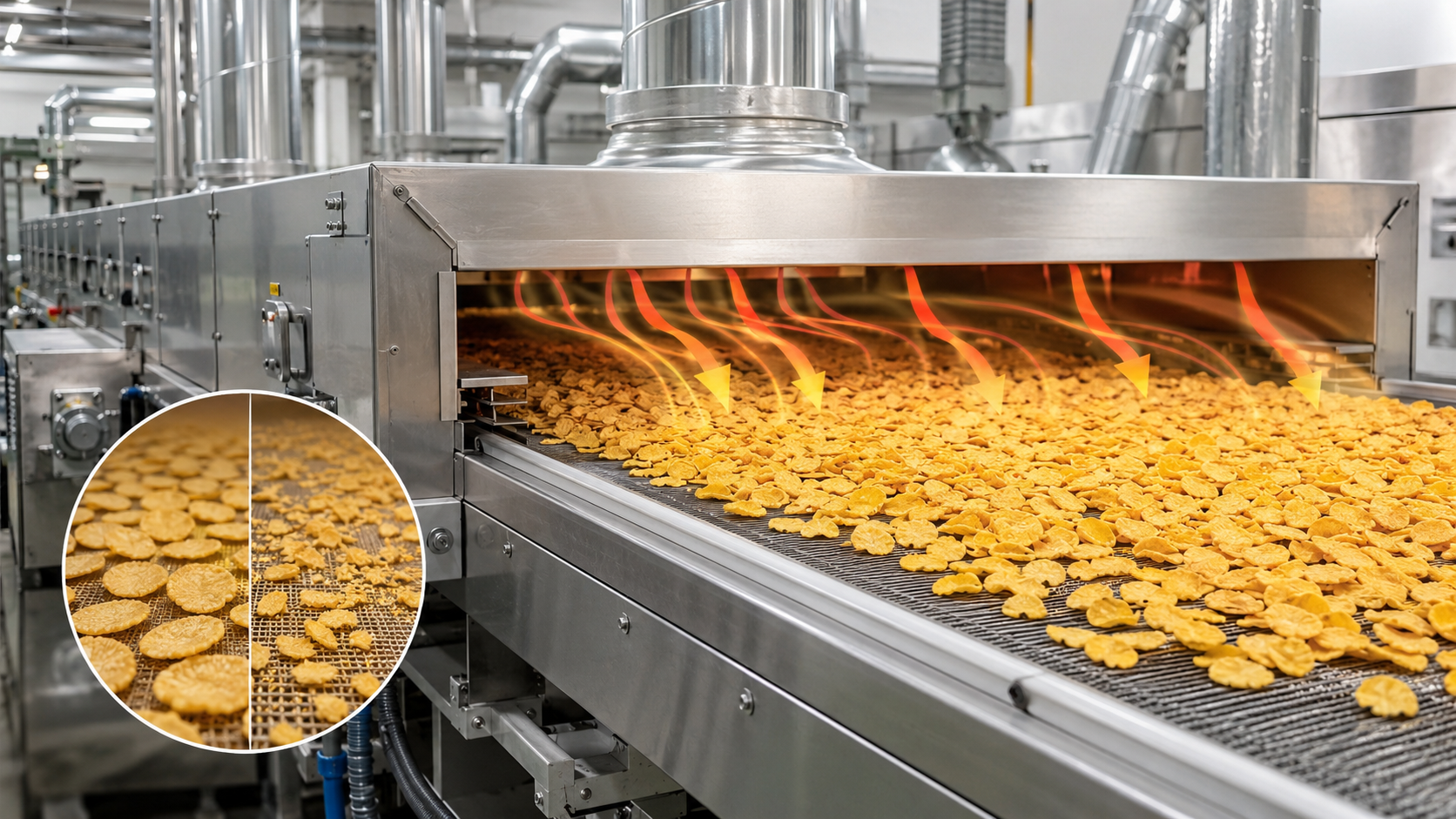
Uneven Airflow Causes Uneven Final Moisture
Uneven airflow creates different product conditions in the same dryer. Some flakes become too dry and break easily. Others remain too moist and may lose shelf stability. Air path design, belt loading, and product distribution all matter.
The dryer should match product form, material layer, and final moisture target, not only rated capacity. In many texture solutions for breakfast cereals, balanced drying is more useful than simply raising the temperature.
Over-Toasting Can Increase Breakage
Toasting improves color, aroma, and crunch, but excessive toasting can make flakes brittle. Operators should review color, moisture, taste, and breakage together.
When toasting and cooling are not balanced, flakes can leave the hot zone under stress. Rough transfer can raise breakage before coating or packaging.
Coating, Cooling, and Conveying Issues
Uneven Syrup or Flavor Coating
Coating can also affect breakage. Uneven syrup spraying may create wet spots, clumps, or sticky surfaces. If coating is followed by insufficient drying, flakes may stick together and break during separation. If the drum runs too aggressively, edge damage may increase.
For sweetened cereals, spraying volume, drum speed, drying time, and cooling should be adjusted together.
Cooling and Handling Are Often Overlooked
Hot flakes should not go directly into packaging. Without proper cooling, moisture can condense and reduce crispness. Rough conveying, high drop points, and sharp turns also raise the broken-flake ratio.
How to Reduce Breakage Through Line Balance
Control Moisture at Key Stages
Start with moisture control. Check raw materials, extrudate condition, flake moisture, and product temperature before packing. This helps locate where breakage begins.
Match the Main Equipment as One System
A strong line is not built by selecting machines separately. The extruder, flaking roller, dryer, toaster, cooler, coating system, and packaging must match in capacity and product handling. If extruder output exceeds dryer or cooler capacity, quality may become unstable.
For plants reviewing a new or upgraded Corn Flakes Production Line, the key question is whether each stage can keep flakes stable while meeting planned capacity.
Run Trials Before Scaling Production
Different grain blends, sugar levels, coating formulas, and flake thickness targets change the result. Trial runs confirm moisture, screw speed, roller gap, dryer setting, and toasting profile before scale-up.
At ARROW MACHINERY, we work with food extrusion projects where process testing, line configuration, and operator training connect. The priority is to solve the process cause first, then adjust the equipment plan.
When Should a Factory Upgrade Its Corn Flakes Processing Line?
A factory should review its breakfast cereal production line when breakage rises after capacity expansion, batch quality varies, or current equipment cannot support new cereal shapes, coatings, or raw material blends. If the same defect returns, system matching may be the issue.
Factories can review project references through the case center and assess whether layout, drying, or transfer design needs improvement. When process training, layout planning, or maintenance support becomes part of the issue, service support can help connect equipment settings with daily production practice.
Final Thoughts
Breakage usually comes from raw material variation, unstable extrusion, poor flaking control, fast drying, excessive toasting, uneven coating, or rough conveying. A reliable corn flakes manufacturing process controls the product gently at every stage.
For factories planning or improving a line, the best results come from process balance, not only higher capacity. If you are reviewing a project, product target, or quality issue, contact us to discuss process requirements and line configuration.
FAQ
Q: What causes corn flakes to break during production?
A: Common causes include unstable raw material moisture, uneven mixing, poor control in the corn flakes extrusion process, incorrect roller gap, drying that is too fast, excessive toasting, and rough conveying after cooling.
Q: How can factories reduce breakage in a corn flakes making process?
A: Factories should control moisture at each key stage, keep particle size uniform, match roller pressure to product condition, use balanced drying and toasting, and reduce drop height during conveying and packing.
Q: Is equipment capacity the main factor in flake breakage?
A: Capacity matters, but matching matters more. If the extruder, dryer, toaster, cooler, and coating system do not work at the same pace, quality can decline even when each machine has enough rated output.


