




Breakfast cereals and corn flakes stay vital in modern food manufacturing. This happens because they address multiple market demands all together. They offer convenience. They have a long shelf life. They allow simple portioning. In addition, they provide enough versatility to back various nutritional stances. These include traditional family choices as well as high-fiber breakfast cereals, fortified breakfast cereals, and options with greater protein focus.
For producers, this field extends beyond simple buyer recognition. It also concerns managing procedures. A solid cereal item relies on raw material actions, starch changes, moisture handling, form maintenance, surface handling, and end crunch. This explains why a modern corn flakes production line or breakfast cereals production line functions as a combined setup instead of one device. Tasks such as mixing, extrusion, pre-drying, flaking or coating, drying, cooling, and packaging each influence the end outcome.
Why the Category Still Matters
Breakfast cereals remain relevant because they fit both consumer habits and factory economics. A ready-to-eat cereal can be packed, transported, stored, and portioned with relatively low complexity compared with chilled breakfast products. For processors, that makes cereal a category with scalable output and clearly defined control points. For buyers, it remains one of the easiest formats for fast breakfast use, snack use, and private-label development.
The category also works well with process standardization. Corn flakes and many extruded breakfast cereals are based on repeatable steps that can be adjusted for different capacities and recipes. Corn flakes systems can be built around AYE65, AYE78, and AYE98 configurations, while breakfast cereal systems can be built around AHE62, AHE78, AHE90, and AHE98 configurations. That range reflects a practical fact in cereal manufacturing: factories rarely need only one formula, one output level, or one finished shape.
Nutrition is reshaping cereal design
The category is also changing because nutrition targets are changing. Manufacturers are no longer limited to standard corn-based products. Multi-grain breakfast cereals, higher-fiber products, lower-sugar concepts, and fortified cereals are now common development directions. Corn, rice, wheat, oats, buckwheat, quinoa, millet, sorghum, and barley can all support broader product design and stronger nutrition positioning.
Corn Flakes and Breakfast Cereals Are Not the Same Product
Corn flakes fit into the wider breakfast cereal group. However, their production path stands out as quite particular. The item relies on building a flake form. This form needs to pass through drying, toasting, coating, and packing. At the same time, it must provide a pure bite. Plus, it has to maintain a steady crunchy feel in the bowl. This explains why the corn flakes manufacturing process often features a special flaking step. That step comes between pre-drying and toasting.
A standard corn flakes production line uses a series of steps. These include weighing and mixing, extruding, pre-drying, flaking, toasting, cooling, coating, and final drying and cooling. Such a method shows why flake items need more than basic puffing. The sheet has to be shaped uniformly. Moisture needs to be lowered without leading to too much cracking. And toasting must build crunch without burning.
Process precision matters here. Adjustable roll gap control and water-cooled flaking structures help maintain thickness consistency and reduce structural damage. In corn flakes production, mechanical accuracy directly affects final product appearance and bowl performance.
Breakfast Cereals cover a wider product family
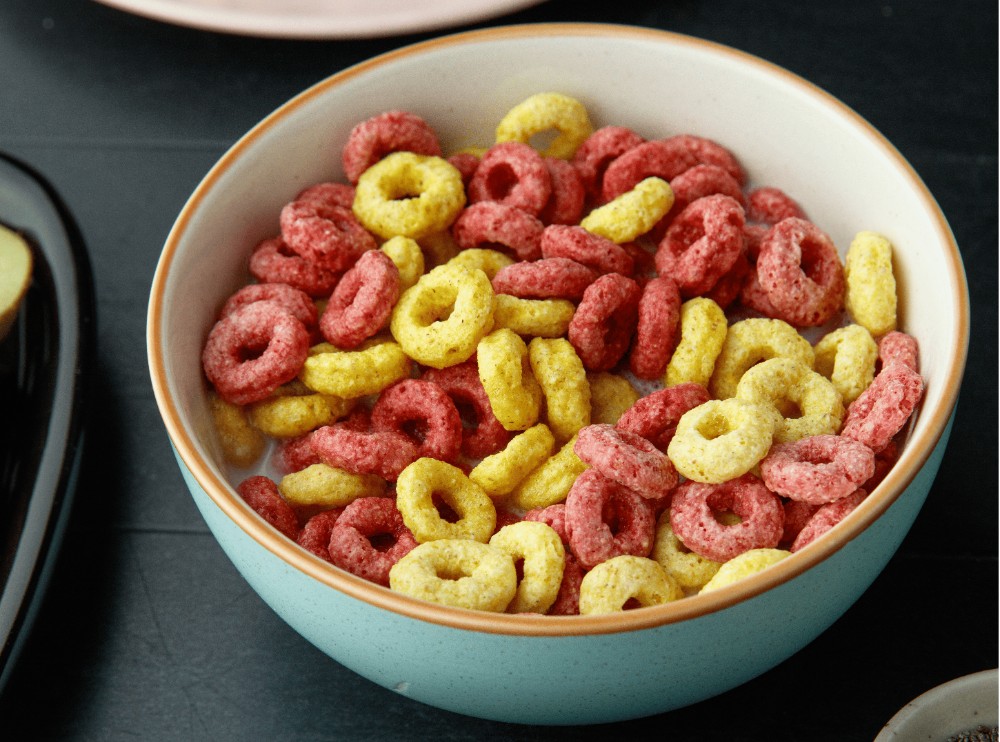
Breakfast cereals cover a much broader group of products, including Froot Loops, Coco Crunch, Core-filled Cereals, Chocolate Cereal, and multi-grain shapes. Their process does not always require a flaking step. A breakfast cereals production line often follows a simpler route of weighing and mixing, extruding, pre-drying, coating, drying and cooling, and packing.
That wider process window matters for product planning. A manufacturer serving different retail channels may need one breakfast cereals production line that can move between family cereals, children’s cereal shapes, coated snack-style cereals, and grain-forward concepts with fewer structural changes. That is one reason twin-screw systems remain central in this category. They support broader formulation flexibility than a line designed around one narrow product form.
How a Modern Corn Flakes Production Line Works
From ingredient preparation to flake formation
In industrial cereal production, the front end determines whether the back end can run consistently. Raw material handling starts with accurate weighing and mixing so the mass entering the extruder has a stable composition. Extrusion then applies thermal and mechanical energy that helps gelatinize starch, distribute moisture, and form a base structure suitable for later processing.
After extrusion, pre-drying removes part of the moisture and prepares the product for controlled flaking. This stage is important because a flake that enters the rolls with poor moisture balance is more likely to crack, deform, or produce uneven sheet thickness. In practical factory terms, pre-drying protects downstream efficiency as much as it protects texture. A good example is the Corn Flakes Production Line, where pre-drying and flaking sit at the center of the process rather than at the margins.
Toasting, coating, drying, and cooling finish the product
Once the flakes are formed, the line moves into texture finishing. Toasting develops crispness and a more stable eating quality. Coating adds sweetness, flavor variation, or product differentiation. Final drying and cooling bring the product into a range that supports packaging and shelf stability.
Moisture that is too high can shorten shelf life or soften the product. Moisture that is too low can increase breakage. Uneven coating can distort both taste and appearance. In cereal manufacturing, drying and cooling are part of the finished product specification, not a secondary support stage.
Why Twin-Screw Extrusion Matters in Breakfast Cereals Production Line Design
Twin-screw extrusion remains central to breakfast cereal manufacturing because it supports recipe flexibility and process repeatability at the same time. One production platform can handle direct expanded cereals, flakes, co-extruded products, and bicolored cereals while also adapting to different grain blends and nutrition targets.
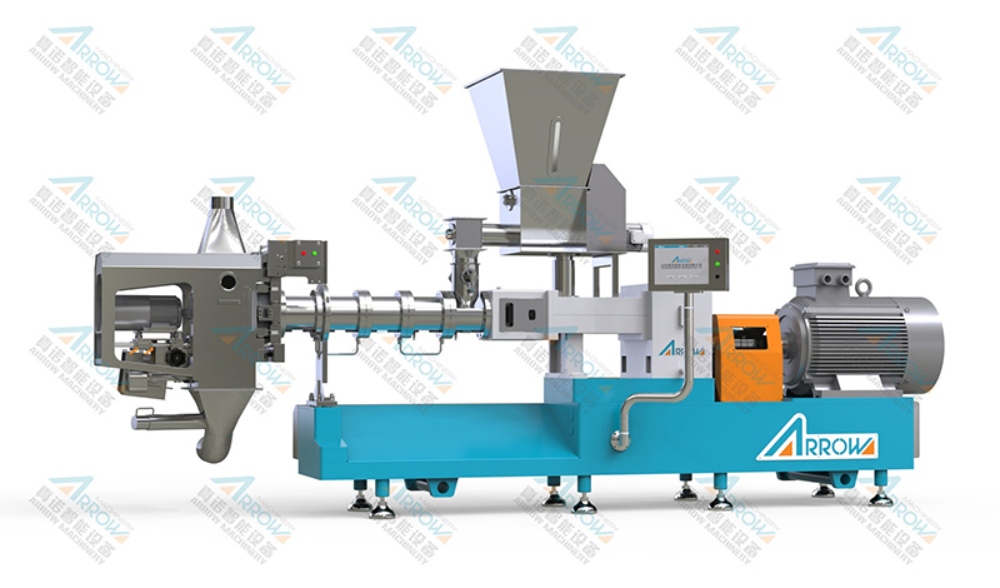
The AHE Series Twin Screw Extruder illustrates that role clearly. AHE62 operates at 90–110 kW with an output of 200–800 kg/h. AHE78 operates at 110–160 kW with an output of 300–1200 kg/h. AHE90 operates at 160 kW with an output of 300–1500 kg/h. AHE98 operates at 200–250 kW with an output of 800–2500 kg/h. Modular chambers, independent heating or cooling control, modular screw design, and an HMI interface all support product shifts, cleaning, uptime, and process stability. These are not abstract features. They directly affect how a breakfast cereals production line performs in daily production.
Process stability depends on downstream fit
Extruder selection also has to match the downstream system. A cereal line performs well only when the extruder, dryer, toaster, flaking unit, coating section, and cooling section are balanced as one process. Process design, equipment selection, trial runs, layout support, training, field debugging, and turnkey project delivery all influence final line performance.
That systems view matters in practice. Cereal plants are built around process coordination rather than isolated machine purchasing. When the line is designed as a whole, product consistency becomes easier to maintain, production losses become easier to reduce, and formulation changes become easier to manage.
What Manufacturers Should Evaluate Before Investing
A cereal project should start with product definition rather than machine preference. The first questions are basic but decisive. Is the target product a flake, a ring, a pillow, or a coated expanded cereal? Does the recipe rely on corn only, or will it include oats, rice, quinoa, or barley? Does the brand want a classic profile, a high-fiber breakfast cereal profile, or a fortified format? These decisions change the process route and the equipment balance.
Capacity planning matters just as much. A line that is oversized may waste energy and reduce operating efficiency during smaller runs. A line that is undersized can restrict product development and create bottlenecks when demand grows. That is why cereal systems cover different line families and output windows, from AYE-based corn flake systems to AHE-based breakfast cereal systems.
For B2B buyers, the key point is not to chase the largest machine. It is to match product form, recipe variation, factory space, labor model, and future expansion plans. A technically correct match usually creates better long-term value than a larger specification chosen without process fit.
Conclusion
Breakfast cereals and corn flakes continue to matter because they sit at the intersection of convenience, process efficiency, and product innovation. The category still supports several growth paths at once: classic flakes, multi-grain cereals, coated shapes, fortified products, and more protein- or fiber-led concepts. That is why cereal manufacturing remains an active engineering field with room for development.
For manufacturers, the critical issue is not whether cereal still has value. The real issue is how to build a process that protects texture, moisture control, output stability, and formulation flexibility at the same time. In that context, ARROW fits naturally into the discussion as a supplier with cereal processing equipment, downstream process design, testing support, layout planning, training, and project delivery capabilities. For teams evaluating a new corn flakes production line or breakfast cereals production line, this kind of integrated approach usually makes the difference between a line that only runs and a line that consistently produces market-ready cereal. Teams that want to compare process routes or factory fit can contact us through the official site.
FAQ
Q:What is the main processing difference between corn flakes and other breakfast cereals?
A:Corn flakes often need a specific flaking stage. This comes before toasting. In contrast, numerous other breakfast cereals depend on expansion, coating, and drying. They manage without any flake-forming step.
Q:Why is twin-screw extrusion widely used in a breakfast cereals production Line?
A:Twin-screw extrusion offers producers stronger command over blending, heat processing, forming, and formula adjustments. This proves helpful if a single line must handle various grains, diverse shapes, or several cereal ideas on the identical setup.
Q:What should a manufacturer check before selecting cereal equipment?
A:The priority points are product type, raw material range, target capacity, downstream drying and cooling design, and the supplier’s ability to support layout planning, testing, installation, and training. These factors affect long-term output quality more than machine size alone.


