




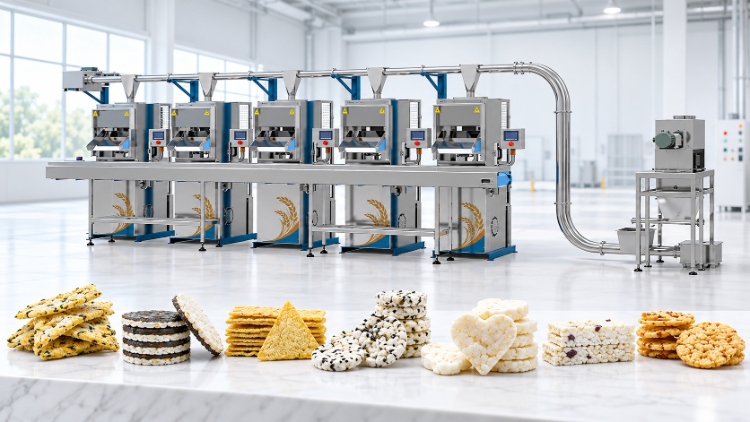
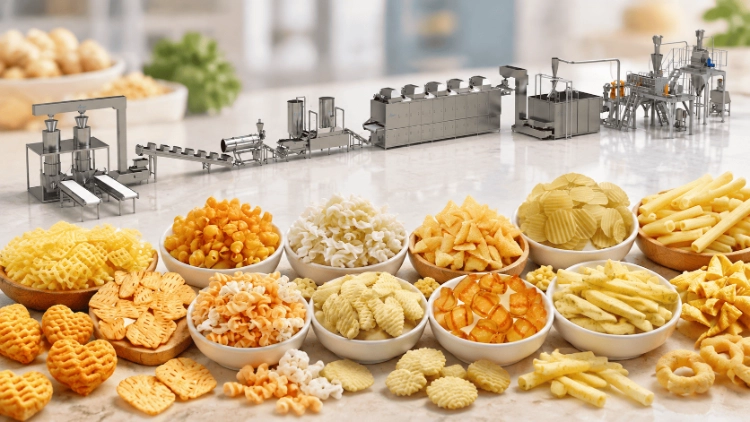
A shell-shaped pellet and a flat snack sheet can leave the same forming line with similar average moisture yet behave differently in a fryer. One expands evenly; the other curls, splits, or remains hard near the center. The difference may begin with wall thickness, openings, or how pieces lie against one another on the dryer belt. Choosing a snack pellet drying process therefore requires more than setting one temperature for an entire product family.
For a factory planning several 2D and 3D designs, shape is a process variable. It changes the path for moisture removal, the way heat reaches the pellet, and the space needed for expansion. Those effects need to be checked before the forming tools, dryer, and finishing equipment are specified.
Why Does Shape Change the Drying Load?
A thin, open sheet exposes much of its surface to moving air. A thick tube has a longer path from its interior to the surface, while a shell may trap another pellet inside its curve. These differences affect how quickly moisture can leave each piece. The dryer must handle the slowest-drying regions without damaging the thinner portions.
Two shapes can also behave differently on a conveyor. Flat pieces may overlap; short tubes can roll into dense clusters; irregular 3D forms can bridge or interlock. When the bed becomes uneven, hot air follows the easier paths.
For this reason, average moisture alone is a weak acceptance measure. Record variation between pieces and, where practical, between thicker and thinner regions of the same shape. A trial should identify whether the problem comes from forming dimensions, product distribution, or the drying conditions themselves.
Start With the Forming Tool, Not the Dryer Setting
Wall Thickness and Cut Length
A die change alters more than appearance. It can change wall thickness, cross-sectional area, and the amount of material in each cut piece. If a new shell design has a heavy seam, that seam may remain wetter than the outer edge after drying. Raising dryer temperature to correct the seam can make the edge brittle before the center reaches its target.
Cut length matters for tubes and spirals. Longer pieces may tangle during transfer, while short pieces can collect in pockets on a belt. The relevant question is whether the selected cutter and forming tool deliver a repeatable shape at the proposed operating rate.
Openings and Enclosed Areas
A hollow pellet is not necessarily easier to dry. Its opening may face the air stream, the belt, or another pellet. A narrow cavity can limit air exchange, especially when pieces accumulate in layers. An open mesh shape offers more exposed edges but may be vulnerable to damage during conveying.
For a mixed product range, establish separate trial groups for flat, tubular, and complex 3D forms.
What Should the Dryer Trial Actually Measure?
The snack pellet drying process begins with a consistent feed. Record moisture at the dryer inlet, the size distribution after cutting, and the rate at which pellets reach the belt. A dryer trial is difficult to interpret if the forming machine changes output or dimensions midway through the run.
Belt loading needs its own record. Note the spread pattern, bed depth, and whether pieces overlap or accumulate along one side. If the factory changes from flat sheets to spirals, the same kilograms per hour may occupy a different volume on the belt. That can change airflow through the product even when the total feed mass remains unchanged.
Collect samples across the belt width and at different times during a stable run. Compare moisture distribution, visible distortion, breakage, and the proportion of pieces outside the agreed dimensional range. Where a thick seam or cavity is suspected, check it separately rather than relying on a single mixed sample.
Dryer residence time and air conditions should be recorded together. A good trial makes it possible to repeat the settings and identify what changed when the next shape is tested.
Why Can a Dry Pellet Fail During Frying?
Drying prepares the pellet for a later expansion step; it does not guarantee that the final snack will expand correctly. During frying, heat reaches the product quickly and residual moisture contributes to expansion. The response depends on the starch structure, moisture distribution, pellet geometry, and the chosen finishing conditions.
A tube with uneven wall thickness may open at its weakest point. A flat piece may curl instead of expanding evenly. A dense, multilayer shape may retain a hard region if the interior does not respond like the outer surface.
Compare the fried product with the corresponding dried sample. Record expansion dimensions, shape retention, breakage, and unexpanded or excessively dark pieces. If the problem appears only after frying, check whether the dried pellet already showed moisture or thickness differences.
Separate Pellet Production From Final Snack Finishing
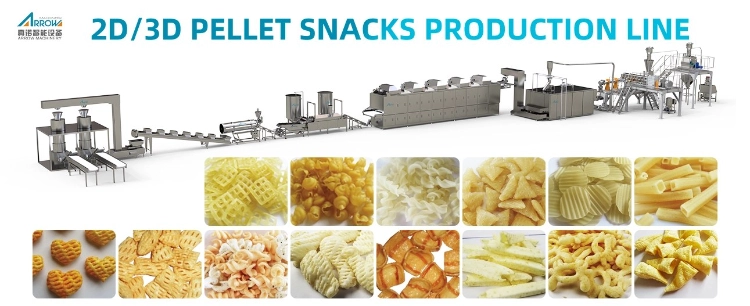
The equipment boundary matters when comparing quotations. ARROW’s 2D/3D pellet snacks production line describes mixing, extrusion, molding, drying, and cooling as its listed flow.
The company’s wider pellet process information also discusses products intended for later frying and seasoning. Those descriptions should not be combined into an assumption that every quoted pellet line automatically includes a fryer.
For a factory selling dried, ready-to-fry pellets, the acceptance point may be the cooled semi-finished product. A factory selling finished fried snacks needs a second performance check after expansion, oil removal, seasoning, and packing. These are different commercial scopes, with different utility and staffing requirements.
Confirm which party supplies the finishing equipment and who is responsible for proving compatibility between the dried pellet and the downstream process. If the final fryer belongs to a customer or another supplier, provide its operating constraints before approving the pellet specification.
Match the Equipment Configuration to the Shape Range
ARROW lists the AYE65, AYE78, and AYE98 on its 2D/3D pellet product information, with nominal capacities of 100–200, 200–300, and 300–500 kg/h respectively. These figures describe published configurations; they do not establish an accepted output for every die shape, recipe, or finishing route.
The company also describes cooking and forming equipment that can be arranged for different pellet products. Its knowledge materials identify starch-based ingredients and examples including shells, spirals, tubes, and flat forms. That range makes die selection and downstream handling part of the purchasing decision, not an afterthought.
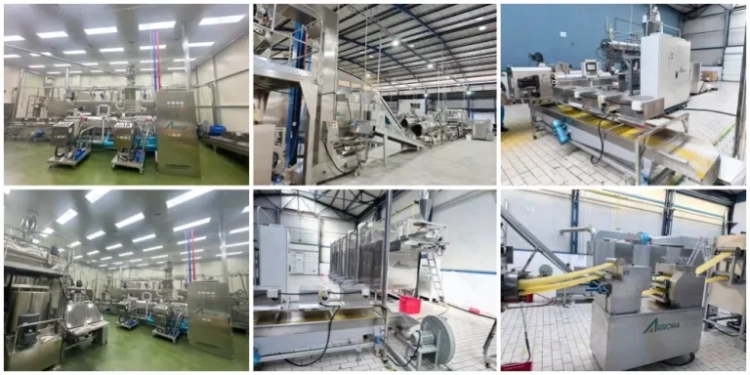
Ask the supplier to identify the forming tools, cutting arrangement, drying modules, cooling equipment, and conveyors included for the actual product range. If a change of shape requires a different cutter or dryer loading pattern, include the changeover procedure and trial time in the project review. A 3D pellet snack machine should be evaluated as part of the connected process rather than by extruder power alone.
Build a Shape-by-Shape Acceptance Matrix
A practical trial matrix gives each proposed shape its own row. It should state the intended dimensions, critical wall or seam thickness, inlet and outlet moisture criteria, acceptable breakage, and the expansion test to be used. The acceptance limits must come from the agreed product specification and trial evidence; there is no single universal target for every starch formulation.
Use at least one representative flat shape, one hollow shape, and one complex shape if those are part of the planned portfolio. Run them under recorded conditions and note whether the dryer or finishing settings need to change. Include the actual saleable output after rejects, not only the feed rate at the extruder.
For 3D pellet moisture control, retain samples from different belt positions and compare them after cooling. For snack pellet frying expansion, use a defined frying method and sample size so results from separate trials are comparable. The final record should show which shapes passed, which need another test, and which require changes to tooling or equipment.
What Should Buyers Send Before Requesting a Layout?
A useful product brief contains more than pictures of the intended snack. Include the raw-material range, target shape drawings or samples, thickness limits, proposed output, and whether the business will sell dried pellets or finished fried snacks. State the available floor space and utility limits as well.
If several products share the line, rank them by expected production volume and changeover frequency. A low-volume decorative shape may justify a separate trial without dictating the whole dryer design. A high-volume tubular product, by contrast, may determine the normal loading pattern and finishing capacity.
ARROW provides technical design, workshop layout guidance, and equipment-operation support. Those services are relevant when the factory needs to connect product trials with a realistic layout, although the exact deliverables should be agreed for the individual order.
Before requesting a proposal, assemble the sample set and acceptance matrix so the discussion starts with measurable requirements.
Conclusion
Pellet shape changes drying because it changes wall thickness, exposed area, movement, and how pieces collect on the belt. It can also change the way the dried pellet expands during frying. A successful trial should connect forming dimensions, moisture distribution, and final product quality instead of treating each machine as an isolated purchase.
The most useful next step is to test representative shapes under documented conditions, then confirm whether the quoted line covers dried pellets only or the complete finished-snack process.
With that distinction clear, a factory can compare equipment configurations against the product it actually intends to sell.
For a project-specific equipment review, send your pellet samples, target shapes to ARROW’s technical team.
FAQs
Q: Does every 3D pellet need a different dryer?
A: Not necessarily. Several shapes may run on the same dryer, but bed loading, residence time, and air conditions may need adjustment. Representative trials should establish which settings can be shared.
Q: Can one moisture reading predict frying expansion?
A: No. Average moisture may conceal variation between thick and thin regions or between pieces. Expansion also depends on the formulation, formed structure, and finishing conditions.
Q: Is a fryer included in every 2D/3D pellet line?
A: No. The published pellet-line flow covers mixing through drying and cooling. Frying and seasoning may be part of a wider project, so their inclusion should be confirmed in the quotation.


