



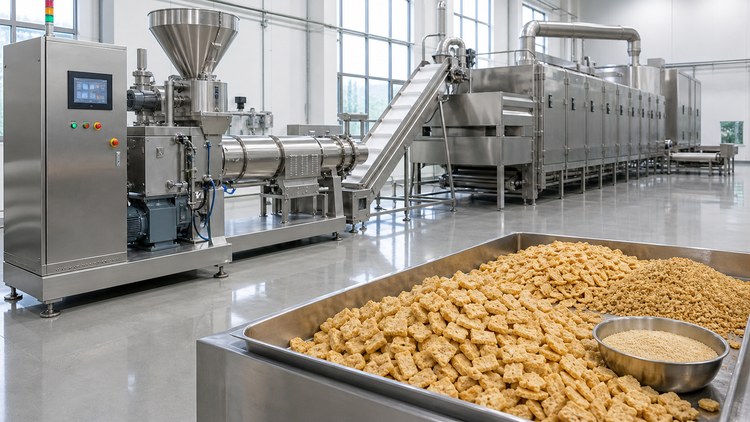
Textured vegetable protein is often the first protein line a food manufacturer adds, and the one most frequently bought by catalogue capacity instead of by product. That mismatch surfaces months later as unstable texture, unexpected yield loss, or a line that cannot run the second SKU the sales team has already promised.
The specification work is not complicated, but the order matters: product form, moisture route, capacity basis, drying, then utilities and acceptance testing. Skipping a step usually means paying for it twice.
Why TVP Capacity Is Moving in 2026
The category is no longer only about flagship plant-based brands. Industry forecasts put the global textured vegetable protein market at about USD 2.00 billion in 2026, growing to USD 2.79 billion by 2031 at roughly 6.9% a year, with soy protein holding close to two thirds of demand. Ingredient majors are rebuilding capacity to match: ADM announced a USD 103 million modernisation in Illinois that covers isolate, textured vegetable protein and other protein lines.
What changed for equipment buyers is the purpose of the tonnage. TVP is increasingly bought as an ingredient — a cost-effective protein source for fillings, ready meals, and blended meat products — rather than as a standalone consumer product. Ingredient buyers ask different questions: cost per kilogram of finished protein, hydration behaviour, and how consistently the piece performs in someone else’s recipe. Those questions are answered upstream, in how the line is specified.
Define the Product Form Before the Machine
A TVP line can make chunks, flakes, mince, or fibrous pieces, but rarely all of them well on one configuration. Each form changes the die, the cutter, the drying profile, and the acceptable piece-size distribution.
Write the target product as a measurable specification, not a description. Useful fields are bulk density, hydration time to full softness, texture after twenty minutes in a sauce, piece-size distribution at the die exit and after drying, and colour after rehydration. Where a second product is planned, state which one sets the initial design and which changes will require a separate trial.
The product definition is also the cost definition. A chunk line and a mince line may look similar in a quotation but differ in drying load, breakage rate, and the labour needed at packing. A sample bag is not a specification: ask what the sample was run at — moisture, throughput, and die — because texture produced at half capacity rarely survives at full rate.
Low-Moisture and High-Moisture Are Different Businesses
Most TVP is made by low-moisture extrusion, where in-barrel moisture stays in the region of 20–35% and the product is dried afterwards. High-moisture extrusion runs far wetter, uses a cooling die to build fibre, and skips the dryer but costs more per tonne of capacity.
|
Item |
Low-moisture extrusion |
High-moisture extrusion |
|
In-barrel moisture |
about 20–35% |
about 40–70% |
|
Product |
chunks, flakes, mince, granules |
whole-cut, fibrous, meat-like pieces |
|
Drying |
required — drying dominates quality |
not required; cooling die instead |
|
Typical use |
ingredient protein, fillings, blended meat |
ready-meal centre, premium analogue |
|
Line implication |
dryer and sizing decide yield |
die and cooling decide texture |
If both routes are in the business plan, treat them as two lines sharing upstream preparation, not one line with a change kit. The high-moisture protein production line page describes the second case; the TVP project route covers the low-moisture case that most new capacity follows. The investment logic differs too. A low-moisture line earns on volume and cost per tonne, so drying efficiency and uptime dominate the payback. A high-moisture line earns on product positioning, where texture and piece integrity support a higher price per kilogram and the usual constraint is the cooling die and the packing format.
Capacity: Nameplate, Stable Run, and Yield Are Three Numbers
Quotations usually quote one number. Specification should require three.
Nameplate capacity is the theoretical maximum at a stated product. Stable-run capacity is what the line holds across an eight-hour shift without operator intervention beyond normal adjustment. Yield is kilograms of saleable product per kilogram of dry input, after start-up losses, off-spec material, and fines.
Ask for each figure against a named product, a stated finished moisture, and a stated piece size. A line rated at a high tonnage on a coarse chunk may lose a third of that figure on a fine flake. Size the line for the stable-run number with modest headroom — not for a nameplate figure that only appears in the first hour of a trial. Two quotations are rarely comparable until they are normalised. Put both against the same product, the same finished moisture, and the same definition of yield, then compare the included scope — sizing, dust collection, dryer and controls are the items most often present in one offer and absent from the other.
Raw Material and Water Decide More Than Screw Design
Two factories can run identical extruders and produce different TVP. The usual reason is upstream.
Defatted soy meal varies by supplier in protein dispersibility, particle size, and residual fat. Flour, concentrate, and isolate behave differently in the barrel and require different water and temperature windows. A specification that names only “soy protein” leaves the most important variable open.
Water dosing accuracy matters more than total water volume. Small errors shift hydration and texture across the whole run, so the inline dosing arrangement and its calibration interval belong in the specification. The same applies to minor ingredients — colour, calcium salts, and premix additions — where feeder accuracy, not extruder power, sets consistency. Background on the material side is covered in the production of soy protein.
Drying and Cooling Set the Final Texture
In low-moisture TVP, the dryer is not a finishing step; it is part of the process that determines texture. Drying too fast hardens the surface and traps moisture inside, which later shows up as slow hydration and a hard core. Drying too long makes the piece brittle and raises breakage between the dryer and the packing line.
Specify the dryer against residence time, airflow distribution, and the moisture curve — not only against evaporation capacity. Then specify cooling: packing warm product produces condensation in the bag and inconsistent texture in the customer’s warehouse. Equipment options sit under main equipment. Start the layout from the utility envelope rather than from the machine footprint: available steam, water treatment, and dust extraction usually decide the arrangement of dryer, cooler, and packing.
Utilities, Footprint, and Changeover
Steam pressure and availability, water quality, compressed air, connected power, dust extraction, and floor loading all constrain the layout earlier than most buyers expect. A line that fits the drawing but exceeds the boiler capacity is not a working line.
Changeover deserves its own requirement. If three SKUs are planned, ask for the changeover time between them, what has to be cleaned, and which parts a single operator can handle. Cleaning access is easier to design in than to add afterwards.
Where New TVP Lines Lose Money in the First Year
Three losses recur in commissioning. The first is over-drying, accepted because the moisture reading looks safe; the product then hydrates slowly and buyers report it as poor texture. The second is fines: a die and cutter combination that produces an acceptable sample but a wide size spread, so a growing share of output is downgraded. The third is idle time at changeover, where cleaning and reassembly take longer than the production run.
None of the three shows up in a quotation. Each can be tested before purchase: run a longer trial and sieve the output, ask for the drying curve rather than a single endpoint reading, and ask one operator to perform a changeover while you time it.
What to Put in the Specification
Write the document around outcomes, not around components: the products and their measurable targets, the capacity basis and yield definition, the raw material range the line must accept, the drying and cooling requirements, the utilities available on site, the changeover expectation, and the acceptance test.
Component lists tend to be copied from previous projects and quietly exclude the parts that decide performance — sizing, dust control, and the interface between dryer and packing.
Acceptance Testing: What to Measure
Agree the test before the trial, in writing. A practical protocol runs the line for a continuous four to eight hours on the named product, samples at fixed intervals, and records finished moisture, bulk density, piece-size distribution, texture after rehydration, breakage rate, and yield against dry input.
Define pass and fail in advance, and define who signs the result, so a borderline run is not settled by opinion afterwards. Keep the records with the machine — they are the baseline for every future comparison. They also settle later questions about whether a change came from material, operation, or equipment.
FAQ
Q: Can one TVP line run both low-moisture and high-moisture products?
A: Not as a normal production arrangement. The two routes differ in in-barrel moisture, die design, and whether a dryer is needed. Sharing upstream preparation is practical; sharing the extruder and downstream as a routine changeover usually produces compromise on both products.
Q: What capacity figure should be used for factory planning?
A: The stable-run figure on the named product, with a modest margin. Nameplate capacity describes a peak that is rarely sustained, and planning utilities or labour against it leaves the plant short in normal operation.
Q: How much does raw material variation really affect TVP quality?
A: It is one of the most common causes of inconsistency. Protein dispersibility, particle size, and residual fat in defatted soy meal change how the material hydrates and texturises, so the line should be specified against a defined material range rather than a single sample.
For projects where the product range is still open, we would rather review the targets first and size the line second. Send the product list, target output, and available utilities through contact us and we will respond with a configuration and the questions that still need answers.


