



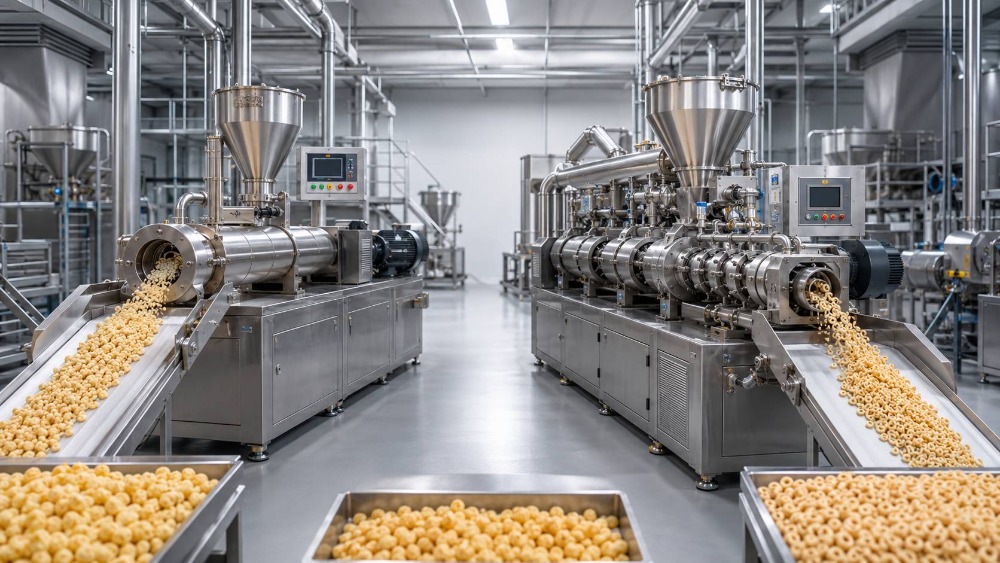

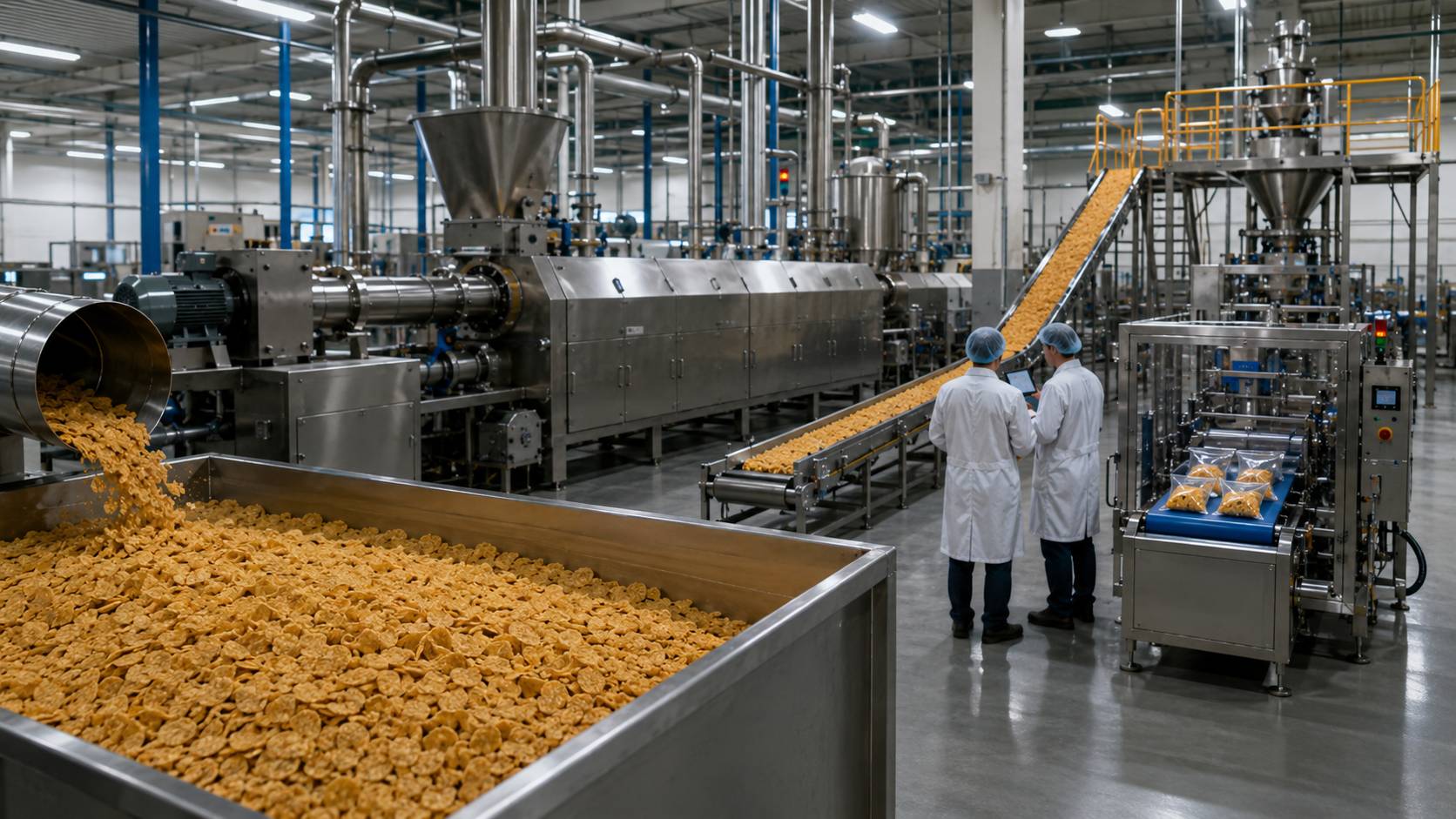
An automatic corn flakes production line is a complete factory project, not a single machine purchase. For cereal manufacturers, private-label suppliers, and food plant investors, the real investment question covers equipment cost, stable output, workshop layout, utilities, and the product range the factory wants to sell after launch.
A buyer may start with a price request, but a useful quotation needs more detail. Plain flakes, honey-coated flakes, whole grain flakes, and high-fiber cereal chips place different loads on mixing, flaking, toasting, coating, drying, and cooling. A well-planned corn flakes production line connects these sections so the final product reaches the target texture, thickness, flavor, and packing condition.
What Drives Cost Before a Factory Requests a Quotation?
Cost is often the first question, yet it should not be separated from the finished product plan. A low quotation may leave out key sections, while a higher quotation may include automation, larger drying capacity, better control, and layout support. The buyer needs to know what is included before comparing suppliers.
Product type changes the equipment configuration
Product style affects cost from the start. Standard corn flakes need stable extrusion, pre-drying, flaking, toasting, and drying. Coated flakes need syrup handling and accurate coating control. Multi-grain products may need more flexible raw material storage and weighing. If a factory plans to make several SKUs, the cornflakes machine line should be configured for that range rather than for one trial recipe only.
Automation changes both price and labor demand
A full automatic cornflakes production line normally requires automatic conveying, weighing, mixing, PLC control, temperature control, and coordinated operation between major sections. This raises the initial cost, but it reduces manual feeding, operator variation, and batch inconsistency. For a plant running retail or export orders, repeatability often matters more than saving a small amount at the purchasing stage.
Supporting systems must be counted
The extruder is the core, but it is not the whole investment. A complete corn flakes machine line may include raw material feeding, mixer, twin-screw extruder, pre-dryer, Flaking System, toaster, coating system, dryer, cooler, conveyors, control cabinet, spare parts, installation, and commissioning. Buyers should ask for a clear equipment list, not only the price of one machine.
How Should Buyers Choose the Right Capacity?
Capacity affects investment size, workshop space, labor planning, and future sales. The rated output of one machine is useful, but the practical output depends on the formula, flake thickness, moisture target, coating ratio, heating source, and packing speed. The whole line must be balanced.
Capacity should match daily production demand
For commercial planning, buyers can begin with three common output ranges. These ranges help match the line to the plant’s sales target and working schedule.
| Model | Power | Capacity |
| AYE65 | 37–75 kW | 150–500 kg/h |
| AYE78 | 55–90 kW | 300–800 kg/h |
| AYE98 | 110–160 kW | 800–1200 kg/h |
A regional brand with flexible recipes may select a smaller line. A factory supplying private-label cereal may need a larger system because delivery windows, packing shifts, and raw material supply must stay stable.
Balanced sections decide real output
The extruder can only support the rated output when the later sections can keep pace. If the pre-dryer removes moisture too slowly, the flaking process becomes unstable. If the toaster residence time is too short, crispness and color may vary. If the final cooler is too small, warm cereal may stick before packing. A good capacity plan reviews each section as part of one process.
Product expansion may require reserve capacity
Many buyers start with flakes and later add cereal loops, Core-filled Cereals, high fiber cereals, or other cereal products. A breakfast cereal production line can support wider recipe and shape development when the layout and post-processing sections allow future changes. Planning reserve capacity is often cheaper than rebuilding the workshop after the first production season.
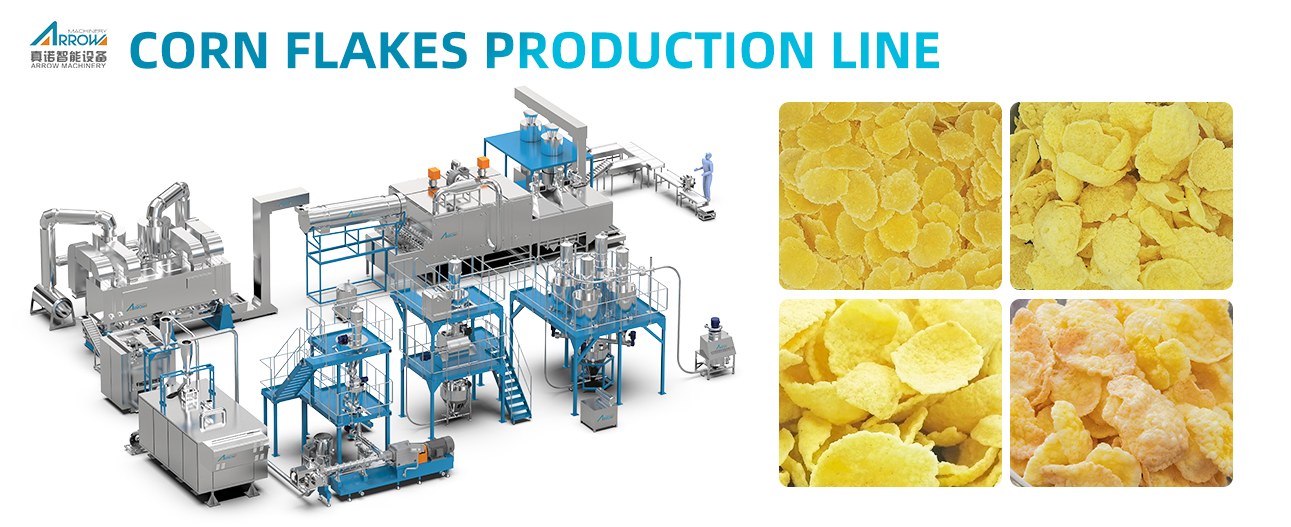
Which Process Sections Decide Corn Flakes Quality?
The production process is not only a path from raw material to finished cereal. Each section controls one part of quality. Buyers who know these links can discuss equipment choices with more precision.
Weighing and mixing control formula stability
Raw material distribution and weighing affect every batch. Corn flour, wheat flour, oats, sugar, minor ingredients, and flavor materials must enter the process in stable ratios. Automatic weighing and mixing reduce manual error and help the factory keep a repeatable base formula, especially when several recipes share one line.
Twin-screw extrusion sets the cooked base
During extrusion, the screws convey, mix, shear, cook, and shape the material under heat and pressure. This step forms the cooked base that later becomes flakes. A reliable food twin screw extruder supplier should explain screw configuration, barrel control, torque stability, die design, and cleaning access, because these details affect texture and uptime.
Flaking, toasting, coating, and drying finish the product
After extrusion and pre-drying, the roller flaking machine presses the cooked material into a controlled thickness. Toasting builds crispness, roasted flavor, and surface color. Coating adds sugar, honey, maltose, cocoa, or other flavor agents. Final drying and cooling stabilize the cereal before packing. Weak control can cause broken flakes, uneven color, sticky coating, or poor shelf stability.
What Factory Setup Details Should Be Planned First?
Factory setup should begin before the final order is placed. The line is long, and each section needs space for operation, cleaning, repair, and material flow. A good layout also helps reduce installation changes after equipment delivery.
Layout should follow material flow
A practical layout moves raw materials from storage to mixing, then to extrusion, pre-drying, flaking, toasting, coating, drying, cooling, and packing. The line should avoid unnecessary turns and narrow service spaces. Operators need safe access around rollers, dryers, burners, coating drums, and control cabinets.
Utilities affect installation and operating cost
Power supply, compressed air, ventilation, dust control, and heating source should be checked early. Drying and toasting may use electricity, gas, fuel oil, or steam. If the local factory has limits on gas supply or electrical load, the full automatic cornflakes production line should be designed around those limits before manufacturing begins.
Packing connection should not be an afterthought
Corn flakes must be cooled before they move into bags, cartons, or other retail packaging. The packing area needs enough space for weighing, sealing, coding, cartoning, and quality checks. If nitrogen filling or multiple pack sizes are planned, the production exit and packing connection should be included in the layout from the beginning.
How Can Buyers Evaluate a Suitable Supplier?
The supplier decision should focus on project fit. A cereal factory needs process design, capacity matching, installation support, and training that help the line reach stable production faster.
Ask for a process plan, not only a price
A qualified cereal equipment manufacturer should provide a process flow, equipment list, capacity basis, utility requirements, and workshop layout suggestions. Buyers can also review the solution center to compare cereal projects with other extrusion applications before narrowing the configuration.
Trial and recipe support reduce startup risk
Recipe details change texture, color, and breakage rate. Moisture level, flake thickness, coating ratio, and toasting time all need adjustment during startup. At this stage, working with Arrow Machinery gives buyers access to project discussions around food extrusion equipment, process configuration, and production application.
Service support matters after delivery
Installation, field debugging, operator training, spare parts, and troubleshooting have direct value in the first months of production. Our Service support covers technical design, digital services, consultation, field debugging, operating training, spare parts supply, and troubleshooting. This is important for new cereal factories and for plants moving from semi-manual production to automated cereal processing.
For buyers comparing cost, capacity, and factory setup, the next step is to prepare the target output, product type, workshop size, heat source, automation level, and packing plan. We can review these details and suggest a suitable line configuration based on real plant conditions. Contact us to discuss a project proposal before final equipment selection.
FAQ
Q: What information should a buyer prepare before asking for a quotation?
A: Prepare the target capacity, product type, raw materials, coating plan, working hours, workshop size, available heat source, packing format, and automation needs. These details help the supplier match equipment sections instead of giving a rough price.
Q: Can one breakfast cereal production line make more than plain corn flakes?
A: Yes, the same project direction can support wider cereal development when the process and layout allow it. Depending on the configuration, factories may develop whole grain flakes, coated flakes, fruit-oat chips, rings, or other cereal products.
Q: Why does capacity differ between model selection and real factory output?
A: Rated capacity depends on standard conditions. Real output can change with formula, moisture level, flake thickness, coating ratio, drying time, cooling time, and packing speed. This is why the whole line must be reviewed, not only the extruder model.


