




Consumer tastes in 2026 go beyond traditional tastes and include interesting textures and unique visual experiences. This is helping to drive the rapid development of 3D pellet snacks as consumers move beyond flat crisp snacks and seek an interactive experience in terms of shells, screws, spirals, and other multi-dimensional crunch experiences.
Producing these premium snacks requires profound raw material knowledge and elite machine engineering. At Arrow Machinery, we combine advanced extrusion technology with complete engineering solutions. With over 30 years of experience, our high-quality equipment proudly serves 5,000+ customers across 118 countries.
With our 50,000 square meters of manufacturing space, we have streamlined the manufacturing of complex snacks. The following guide will walk the reader through the development of a highly efficient 2D/3D Pellet Snack Production line, focusing on the starch-based extrusion technology required to reach the pinnacle of modern retail space.
The Foundation of 3D Snacks: Starch-Based Formulations
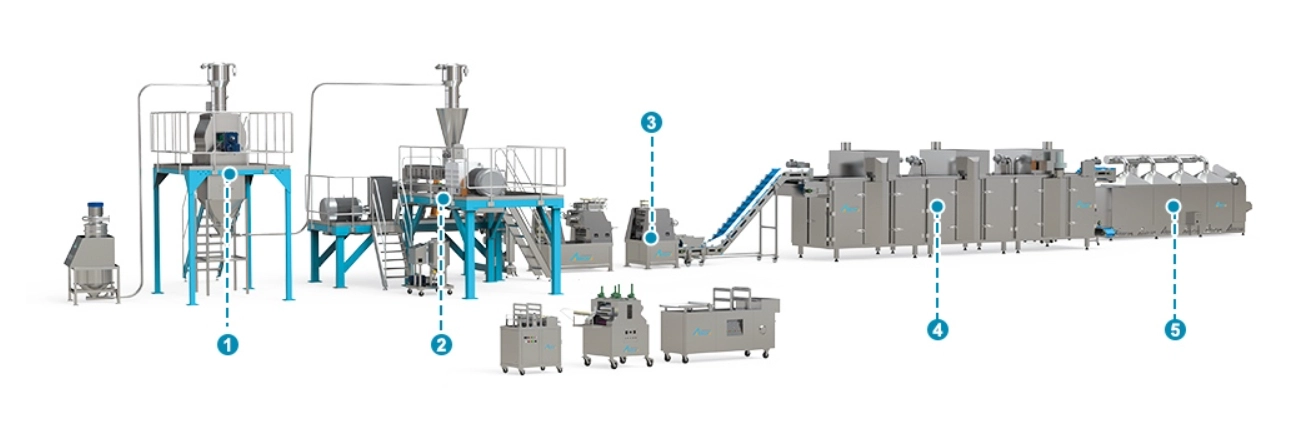
Unlike direct-puffed snacks (such as basic corn curls), true 3D pellets require a highly specific, multi-stage process involving starch gelatinization, precise forming, careful drying, and eventual rapid expansion (usually via deep frying).
The 2D 3D pellets snacks process line achieves its magic by mainly using Most of Grains flour like wheat flour, corn flour, rice flour and other starch-containing grains or roots, such as potato starch, corn starch, cassava starch, tapioca starch etc. The structural integrity of a 3D snack relies entirely on how these starches bind and react to thermal changes.
Through an unbroken sequence of mixing, extruding, cutting, drying, frying, and seasoning, these dense base starches are meticulously transformed into various intricate shapes. After oil frying and flavoring with different premium seasonings, these dense pellets undergo a violent expansion, becoming the crispy and delicious snack food that modern consumers crave. To achieve this structural perfection at an industrial scale, manufacturers must rely on a tightly controlled, five-step production system.
Step 1: Precision Raw Material Handling and Batching
The path to a premium 3D pellet starts well before the materials ever enter the extruder barrel. Exact ingredient mixing forms the base of all steady results, as even a one percent fluctuation in moisture or starch ratios can drastically alter the final expansion rate, causing the 3D shape to collapse or deform during frying.
To eliminate human error, our raw material distribution system can realize the distribution of different materials to different silos. To ensure absolute consistency across every batch, the system adopts high-precision weighing sensor control and is equipped with a variable-speed feeding method to ensure the strictest accuracy requirements of weighing. Various forms of storage bins can be configured to meet the specific storage needs of different starches and flours.
Once accurately weighed, the materials enter our High Efficiency Mixer. These systems offer a round discharge gate to ensure absolutely no material is remaining, preventing cross-batch contamination. By securing the exact thermal and mechanical traits of the raw mix during this initial hydration stage, the starches are perfectly prepped for the rigorous cooking environment.
Step 2: Advanced Cooking and Forming Extrusion
The heart of the 2D/3D production line lies in its dual-extrusion strategy: a twin-screw stage for high-temperature cooking, it then immediately proceeds to a single-screw extruder for forming. This system is engineered to handle dense, high-viscosity starches such as potato and cassava starch without causing premature expansion.
Standard Excellence with AYE + J Series
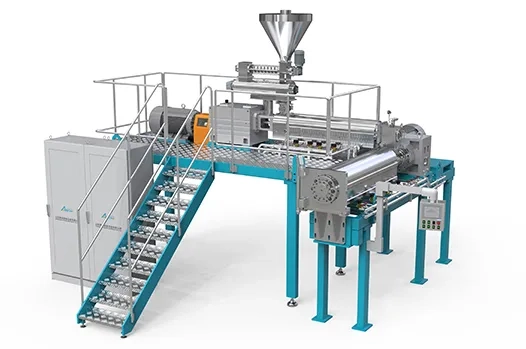
For established high-volume production, our AYE series twin-screw extruders (such as the AYE65 or AYE78) serve as the robust cooking core. When paired with the J series single-screw forming extruders, the system achieves a clear functional division: the twin-screw ensures complete starch gelatinization, while the single-screw delivers the fully cooked dough to the molds at controlled temperatures.
Step 3: Controlled Drying for Structural Integrity
Once formed and cut, the pellets are in a wet state and must be carefully dried to lock in their complex 3D geometry. Inadequate drying leads to warping, while over-drying causes cracking—both of which destroy the final expansion potential during frying.
To solve this, we utilize a Multi-functional Combined Dryer (Continuous Belt Dryer) specifically optimized for pellet products.
- Customized Airflow: The dryer utilizes food-grade stainless steel chain plates, which are more durable and hygienic than traditional wire belts. The chain plate holes can be customized with elliptical shapes according to product size, facilitating superior hot air penetration and circulation through the dense pellet beds.
- Advanced Safety Design: Our safety configuration features a top-mounted combustion chamber. This prevents food dust and fine particles from falling onto heating elements, significantly reducing fire hazards during continuous operation.
- Uniform Distribution: An oscillating fabric distributor ensures that the wet pellets are spread evenly across the dryer belt. This prevents product accumulation at the inlet, ensuring every pellet achieves a consistent moisture level for perfect expansion later.
- Smart Efficiency: The equipment uses a closed-loop air circulation design and an independent dehumidification fan. This maximizes heat utilization and can reduce overall processing time by more than 50% compared to conventional drying systems.
Step 4: High-Speed Frying and Volumetric Expansion
Once perfectly dried to the precise moisture threshold (typically around 10-12%), the glassy pellets are ready to be expanded into their final, crispy form. The frying production line is an automated equipment system used for large-scale production of fried foods, capable of achieving continuous and high-speed production.
As the dense pellets come into contact with the hot oil, rapid heat transfer causes the moisture within the pellets to vaporize instantly. This leads to the rupture of the starch matrix, which expands significantly while maintaining its intricate geometry, increasing in size while retaining its three-dimensional geometry. Due to the automated control system, the quality of the product, as well as taste, is maintained constantly. The design of the fryer is such that it is energy-efficient, which leads to the reduction of fuel consumption as well as energy waste.
Step 5: High-Precision Coating and Seasoning
The final step in capturing consumer loyalty is applying the perfect flavor profile. Consumers in 2026 expect an even, robust taste profile on every single bite, whether it’s a savory cheese, spicy chili, or tangy barbecue. Our Seasoning System is perfectly suitable for large-volume, stable, and continuous spraying, ensuring the smooth operation of the equipment.
To eliminate costly seasoning waste and ensure absolute flavor consistency, the high-precision control of the coating volume is stabilized by weighing sensors and liquid flow meters. Furthermore, the spray pipe is designed with multiple parallel nozzles, featuring a radial range of more than 800mm, which achieves a massive coverage range for complex 3D shapes.
Importantly, the system features advanced oil mist isolation to provide a cleaner production environment. The front and rear ends of the drum are both designed to prevent oil mist diffusion. This prevents oil mist gas from harming production contractors and ensures the pristine cleanliness of the production workshop.
Leveraging Intelligent Automation for Maximum ROI
The most profitable and scalable snack factories in 2026 minimize human error through deep digital integration. From mechanical to automation, the Internet, big data, and artificial intelligence are deeply integrated with traditional manufacturing at Arrow Machinery.
Our Intelligent Factory Control System acts as the core platform for production management. It features a stunning HMI (Human-Machine Interface) based on the WYSIWYG (What You See Is What You Get) design principle, where all parameters are completely displayed on a friendly, interactive interface. Contractors can modify all parameters by touching the screen to complete various tasks seamlessly. This smart system provides robust practicability, managing raw material and finished product data, optimizing Overall Equipment Effectiveness (OEE), and enabling rapid remote operation and diagnosis.
Your Partner in Snack Manufacturing Excellence
Building a highly profitable 3D pellet snack food production line requires more than just excellent machinery; it requires intelligent spatial and operational engineering. By focusing on exact starch mixing, dual-stage extrusion, and smart automation, you can create products that lead the market in visual appeal and crunch.
If you’re planning to build or upgrade a snack food production line, early technical discussions are the foundation of successful project execution. Contact us today, and let our 30 years of expertise turn your innovative snack concepts into a global reality.
FAQ
Q1: What are the best raw materials for producing 3D pellet snacks?
A: Unlike direct-puffed snacks that often use basic corn meal, premium 3D pellets require starches with strong binding and expansion properties. The ideal raw materials include potato starch, potato flour, corn starch, cassava starch, and wheat flour. Our 2D/3D Pellet Snacks Production System is specifically engineered to handle these dense, high-viscosity starch blends.
Q2: Can we change the shape of the 3D snacks easily during production?
A: Yes, the system is designed for high flexibility. By changing the molds on the forming extruder, you can produce various shapes like including 2D pellets in various shapes(screw, shell, net, animal, cartoons), sheet pellets, 3D pellets, and slanty tubes. 2D 3D Snack Pellet Machine can also be customized to meet customers’ specific demands. Additionally, our rotary cutting system features a side push type precision positioning design, which allows your contractors to safely replace the cutting blades without stopping the machine, maximizing your uptime.
Q3: What is the expected production capacity for the 2D/3D pellet line?
A: Depending on the complexity and size of the specific 3D shapes you are producing, our dedicated 2D/3D pellet processing lines typically cover an output capacity ranging from 200kg/h to 500kg/h. For operations requiring different capacities, our technical team can provide customized engineering solutions to match your factory’s exact scale.


